
Sur Ron Supermoto Conversion Kit Guide: 17" Wheels
Complete Sur Ron supermoto conversion kit guide covering 17" wheels, sprocket size, speedometer calibration, tire pressure, and street legality.

Table of Contents
- What a Supermoto Conversion Kit Actually Includes
- 17-Inch vs 16-Inch Wheels: Rotational Mass and Rim Diameter
- Sur Ron Sprocket Size for Street: Gear Ratio Math
- Step-by-Step Installation: Rotors, Caliper Alignment, and Spacers
- Sur Ron Speedometer Calibration After a Wheel Swap
- Electric Dirt Bike Street Tire Pressure and Suspension Tuning
- Legal, Insurance, and Long-Term Maintenance Realities
- Frequently Asked Questions
Last Updated: September 21, 2026
What a Supermoto Conversion Kit Actually Includes
A supermoto conversion swaps a Sur Ron's off-road wheels and knobby tires for smaller-diameter street wheels, road-compound rubber, and matching gearing and brake hardware. We've watched riders order a wheelset first and discover the rest of the bill later, so here's the honest parts list.
A complete kit comes down to four groups:
- Wheelset: 17-inch rims laced to hubs that match your model's axle and spacing
- Tires: street-compound rubber sized to the rim width
- Brake hardware: rotors, and brackets if you step up rotor diameter
- Drive hardware: sprocket, plus the bolts and spacers the wheel doesn't ship with
17-Inch vs 16-Inch Wheels: Rotational Mass and Rim Diameter
Seventeen-inch wheels are the supermoto standard: tire selection is far wider, and the larger rim diameter raises gearing slightly for street speeds. Sixteen-inch sets exist, but the tire catalog thins out fast.
Sur Ron Sprocket Size for Street: Gear Ratio Math
Sprocket size is the biggest handling change most riders overlook. Smaller rear sprockets raise top speed and lower torque; larger ones do the opposite.
| Riding Style | Rear Sprocket Range | What It Does |
|---|---|---|
| Tight urban, stop-and-go | 58-64T | Strong launch, lower top speed |
| Mixed street and backroad | 48-54T | Balanced torque and cruise |
| Long commutes, open road | 40-44T | Higher top speed, softer pull |
Step-by-Step Installation: Rotors, Caliper Alignment, and Spacers
Installation runs about an hour with basic hand tools if everything fits. The friction points are caliper alignment and axle spacers, not the wheel.
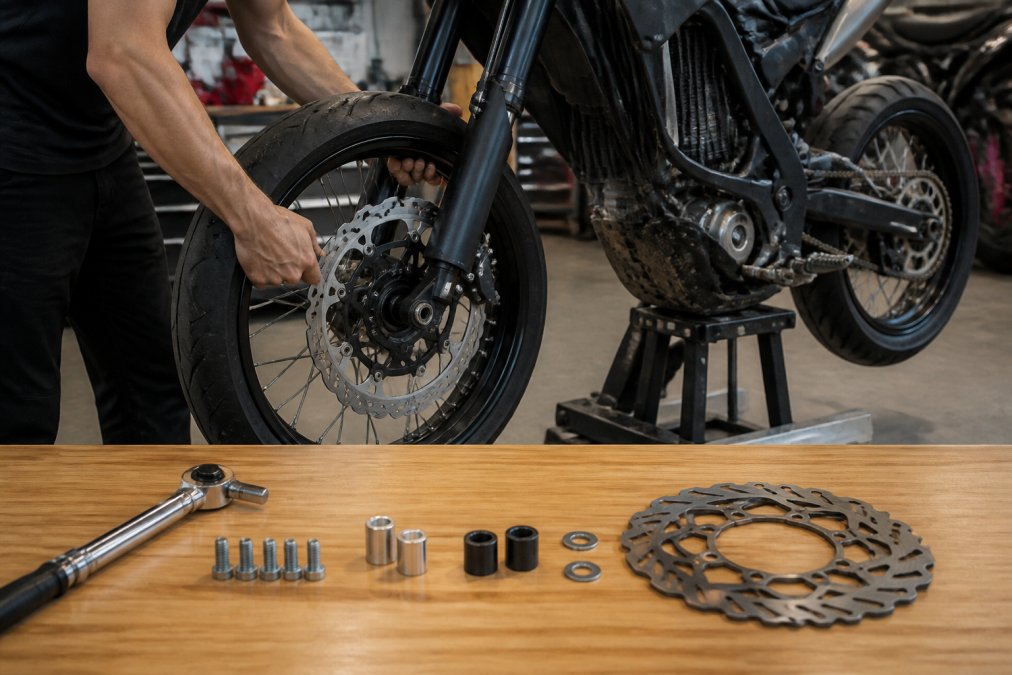
- Support the bike so both wheels are off the ground.
- Remove the front axle and slide the OEM wheel out, keeping the spacers in order.
- Transfer your rotor and sprocket to the new wheel, or fit the upgraded hardware.
- Slide the new wheel in with the correct spacers on each side.
- Torque the axle to spec, then spin the wheel and listen for drag.
- Pump the brake lever until the pads seat against the rotor.
- Repeat on the rear, checking chain alignment and tension before you ride.
Sur Ron Speedometer Calibration After a Wheel Swap
Sur Ron speedometer calibration is the step almost nobody mentions, and it matters most if you care about accurate mileage, range estimates, or staying under a local speed limit. The controller calculates speed from wheel rotation, so changing wheel diameter throws the reading off, sometimes 10 to 15 percent, the difference between a legal 25 mph and a ticketed 29 mph.
The math behind the correction
Stock Sur Ron Light Bee wheels with knobby tires roll out around 2,050 to 2,150 mm per revolution depending on tire and pressure. A 17-inch supermoto wheel with a 110/70-17 front tire lands closer to 1,850 to 1,900 mm, roughly a 10 to 12 percent reduction in rolling circumference, and the same speedometer error if you don't recalibrate.
How to recalibrate on a Sur Ron
Most Sur Ron controllers expose a wheel-diameter or speed-calibration parameter through the display menu, though the label varies by firmware and controller revision. The general procedure:
- Measure true rolling circumference. Tape-mark the tire sidewall, roll the bike forward one full revolution on flat pavement, and measure between the ground marks. This beats any spec sheet because it accounts for your actual tire, pressure, and load.
- Enter the display menu and locate the wheel size or speed calibration parameter. On many units this is expressed in millimeters of circumference; on others it's a percentage multiplier.
- Enter your measured value, or calculate the correction: (new circumference ÷ old circumference) × 100. If the new wheel is 1,880 mm and the old was 2,100 mm, that's 89.5 percent, enter that if the menu uses percentages.
- Ride a known-distance route or compare against a GPS app to verify. A 1-mile stretch should read 1.0 mile, not 0.9 or 1.1.
- Re-check after 100 miles, since tire wear and pressure shift effective circumference slightly.
If your controller doesn't expose the setting
Some older Sur Ron controllers and certain aftermarket units lock the wheel-size parameter. In that case you have three practical options:
Sur-Ron Light Bee X (LBX) 17" Supermoto →
- GPS cycle computer: A handlebar-mounted GPS unit reads true speed independent of wheel rotation. This is the most accurate fix and works on any model year.
- Aftermarket display or controller: Several vendors sell plug-in displays that allow wheel-size entry even when the stock unit doesn't. Confirm pinout and firmware compatibility before buying.
- External speed sensor: A magnetic pickup on the fork leg with a magnet on the wheel gives you a dedicated speed signal you can feed to a standalone gauge.
Why this matters beyond the speedometer
On Sur Rons, the controller also uses wheel-speed data for its own logic, some firmware limits top speed or adjusts power delivery based on calculated speed. If it thinks you're going slower than you are, it may not cut power when it should; if faster, you may lose top-end early. Recalibrating keeps the controller's behavior aligned with reality.
Electric Dirt Bike Street Tire Pressure and Suspension Tuning
Electric dirt bike street tire pressure runs higher than dirt pressures, typically low-to-mid 20s psi on these small wheels. Dirt riders habitually run teens; on pavement that squirms and overheats the carcass.
Legal, Insurance, and Long-Term Maintenance Realities
Street legality is the angle most conversion guides skip, and it can turn a finished build into a garage ornament. A converted Sur Ron may or may not be registerable where you live, and rules vary dramatically by state, not just whether it's allowed, but which legal category it falls into.
The three registration paths
Most states sort a converted Sur Ron into one of three buckets, and which bucket you land in determines what equipment you need and whether insurance is even available:
- Moped / motor-driven cycle: Usually requires lights (headlight, taillight, brake light), a horn, mirrors, and sometimes a speed cap. Some states require pedals or a minimum seat height. Registration is often cheap and insurance may be optional or minimal.
- Road registration: Requires a full lighting kit, DOT-compliant tires, a title, and whatever license endorsement your state requires. Insurance is mandatory in most states. This is the cleanest path if your state allows it, but the title requirement is often the blocker for a bike that was sold as off-road only.
- Off-road only: No street path at all. Some states will not issue a title or registration for a vehicle that was never certified to FMVSS standards, and no amount of aftermarket lighting changes that.
Insurance realities
Insurance follows the title. If the bike isn't titled and registered as a street vehicle, most standard policies won't cover a street incident, homeowner's and renter's coverage typically excludes motor vehicle liability. Once titled, you can usually insure it under a moped or two-wheeler policy, but some carriers decline Sur Rons because of the off-road origin; specialty and powersports insurers are more likely to write it.
Long-term maintenance on aftermarket wheelsets
Aftermarket wheelsets need more attention than OEM wheels, especially the first season. New spokes seat into the hub flange and rim nipple under load, so tension drops after a few rides. Loose spokes let the rim flex, and a flexing rim eventually cracks at the nipple.
| Task | Frequency | Why It Matters |
|---|---|---|
| Spoke tension check | First 3 rides, then monthly | New spokes stretch and loosen as they seat |
| Bearing and seal inspection | Seasonally, or every 2,000 miles | Street grit and water wear bearings faster than dirt |
| Rotor bolt torque | After every wheel change | Vibration loosens hardware; a backed-out bolt can lock the wheel |
| Tire pressure check | Weekly | Pressure drifts with temperature; handling changes noticeably |
| Rim true check | Seasonally | Potholes and curbs knock rims out of true |
| Brake pad inspection | Every 500 miles | Street braking wears pads faster than dirt |
Frequently Asked Questions
What size wheels are best for a Sur Ron supermoto conversion?
17-inch wheels are the standard for street use. The RYVOX Sur-Ron Light Bee X 17" Supermoto Wheel Set runs 17x1.60 front and 17x2.15 rear, while the Warp 9 set steps up to 17x2.15 front and 17x2.50 rear for wider street tires. Smaller 16-inch rims fit more tire sidewall and suit rough pavement, but 17s open up the widest DOT-approved tire selection and better lean angle on asphalt.
Do I need to change my sprocket when switching to supermoto wheels?
Not always, but most riders do. The Sur Ron sprocket size for street use typically lands between 48T and 54T. Taller gearing (smaller tooth count) drops RPM at speed and stretches range; shorter gearing (larger count) keeps torque delivery punchy for stoplight launches. Warp 9 supermoto sets let you specify 40T through 64T at checkout, so you can match your controller and riding style.
Is a supermoto conversion legal for street use?
It depends on your state and how the bike is titled. A Sur Ron Light Bee X is not sold as a street-legal vehicle, so converting one for road use usually means registering it as a moped or road-going two-wheeler, adding DOT-approved tires, mirrors, lights, and a horn, and checking with your state DMV. Insurance carriers may also require an inspection. Confirm requirements before you buy parts.
Do I need to adjust controller settings after a wheel swap?
Yes, in most cases. Smaller 17-inch wheels change the effective gear ratio and reduce rotational mass, so the controller sees different load characteristics. Speedometer calibration is also required because the wheel circumference changed, which throws off the displayed speed. We verify fitment against your exact model and year before shipping, so you know the wheelset and any rotor or sprocket upgrade will bolt on without surprises.