
Sur Ron vs Talaria: Performance Comparison 2026
Sur Ron vs Talaria performance comparison: top speed, torque, suspension, and upgrade paths. Find out which e-moto fits your riding style best.

Table of Contents
- Sur Ron vs Talaria Performance Comparison: Quick Specs Table
- Top Speed and Acceleration: Stock vs Modified
- Battery Range, Capacity, and Range Extension Options
- Suspension, Handling, and Trail Performance
- Build Quality, Weight, and Long-Term Maintenance Costs
- E-Moto Aftermarket Performance Parts and Upgrade Paths
- Best Electric Dirt Bike for Beginners: Which Platform Is Easier to Start On?
- Legal and Registration Requirements, Safety, and Ergonomics
- Frequently Asked Questions
Last Updated: September 20, 2026
Sur Ron vs Talaria Performance Comparison: Quick Specs Table
The sur ron vs talaria performance comparison starts with a simple truth: both platforms share the same basic architecture, but they diverge sharply once you push them. At RYVOX, we've watched riders argue about this matchup for years, and the honest answer is that stock-for-stock, the gap is smaller than the internet suggests. Where it opens up is in the aftermarket.
A Sur Ron Light Bee X and a Talaria Sting MX5 both run a mid-drive motor, a chain final drive, and a similar frame layout. What changes is tuning philosophy, controller headroom, and how much the platform rewards upgrades.
Below, we'll break down the real differences in speed, range, suspension, and long-term cost, plus the legal and ergonomic factors most spec sheets skip.
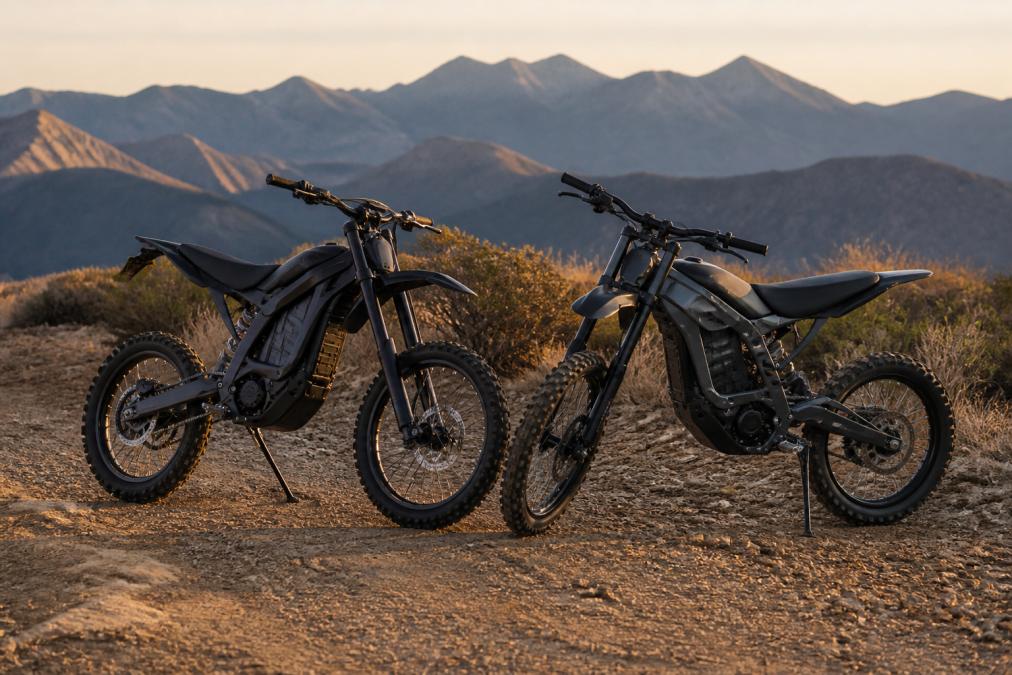
| Category | Sur Ron Light Bee X | Talaria Sting MX5 | Edge |
|---|---|---|---|
| Stock top speed | ~45 mph | ~47 mph | Talaria |
| Low-end torque | Strong, abrupt | Smooth, linear | Sur Ron |
| Battery capacity | 60V, ~32Ah | 60V, ~38Ah | Talaria |
| Curb weight | ~110 lb | ~121 lb | Sur Ron |
| Suspension travel | ~8 in front | ~8 in front | Tie |
| Aftermarket depth | Very deep | Deep, growing | Sur Ron |
| Street legal path | State-dependent | State-dependent | Tie |
Full disclosure: exact specs shift by model year and trim, so confirm fitment against your specific bike before ordering parts.
Top Speed and Acceleration: Stock vs Modified
Stock, the Talaria Sting MX5 holds a slight top-speed edge, while the Sur Ron Light Bee X delivers punchier low-end torque. That difference matters more than the top-speed number for most trail riders.
Midrange acceleration is where the Sur Ron feels faster in practice. Its throttle response is more aggressive off the line, which suits technical climbs and quick bursts. The Talaria is smoother and more predictable, which newer riders tend to prefer.
Once you go modified, the platform matters less than the controller and motor you bolt on. A high-output controller transforms either bike. For example, the EBMX X-9000-V3 Controller Kit runs up to 50kW with 1000A continuous phase current, and it fits both the Sur Ron Light Bee and the Talaria MX3, MX4, and MX5.

Battery Range, Capacity, and Range Extension Options
Range is the spec riders argue about most and understand least. The headline numbers, 60V and roughly 32Ah on the Sur Ron Light Bee X versus 60V and roughly 38Ah on the Talaria Sting MX5, describe pack capacity, not distance. Multiply volts by amp-hours and you get watt-hours, the figure that actually predicts trail time. That puts the Sur Ron pack near 1,920Wh and the Talaria near 2,280Wh, a gap of roughly 18% in stored energy. In practice, most riders report the Talaria going meaningfully farther at the same pace, but the spread between a hard-charging rider and a smooth one on the same bike is wider than the gap between the two bikes.
Three factors move range more than anything else:
- Throttle discipline. Hard acceleration and repeated full-power pulls drain the pack fast. A rider who short-shifts and rolls off early can see a large swing in miles per charge versus one who pins it.
- Field weakening settings. Field weakening trades efficiency for top-end speed. Turning it down extends range noticeably on some tunes; leaving it aggressive costs you distance.
- Gearing. Taller gearing trades acceleration for distance, and shorter gearing does the opposite. Sprocket changes are the cheapest range lever on either platform.
Charging matters too. Both platforms ship with stock chargers that refill the pack in a few hours, and the Talaria's larger pack takes proportionally longer on the same charger. If you ride back-to-back sessions, a second charger or a higher-output unit changes your day more than a few extra amp-hours.
For range extension, the biggest lever is a higher-capacity battery, followed by controller tuning. A controller with adjustable regenerative braking helps recover energy on descents, which matters most on long downhills. The VTB Aetos Max Controller supports intelligent regenerative braking and tuning through a mobile app, and it fits both the Sur Ron Light Bee and the Talaria Sting.

For a deeper look at how range claims are tested, see the U.S. Department of Energy vehicle efficiency data.
Suspension, Handling, and Trail Performance
Both bikes use a similar suspension layout, and both feel undersprung for aggressive riders at stock settings. Trail performance comes down to setup more than brand.
EBMX X-9000-V3 CONTROLLER KIT →
Frame geometry is nearly identical in feel, so handling differences trace back to weight and tune. The Sur Ron's lighter curb weight makes it easier to flick through tight singletrack. The Talaria's extra mass gives it a slightly more planted feel at speed but demands more effort to change direction.
Suspension travel is comparable out of the box. Where riders notice the gap is in damping quality and spring rate for heavier riders. A revalve or spring swap is the single highest-value handling upgrade on either platform.
Build Quality, Weight, and Long-Term Maintenance Costs
Build quality is close, but the Sur Ron's deeper aftermarket means replacement parts are easier to source and often cheaper.
| Maintenance Item | Typical Interval | What Drives the Cost |
|---|---|---|
| Chain and sprockets | Inspect every few rides; replace chain around 1,000-1,500 miles of trail use | Dirt and grit accelerate stretch; a worn chain eats sprockets |
| Brake pads | Front pads often every few hundred trail miles; rear lasts longer | Trail braking and mud wear pads fastest |
| Tires | One to two sets per year for regular trail riders | Knobby wear on hardpack and pavement |
| Battery health | Capacity fades over years, not months | Charge habits and storage temperature matter most |
The NHTSA guidance on off-road vehicle safety is worth reviewing before you ride either platform hard.
E-Moto Aftermarket Performance Parts and Upgrade Paths
The Sur Ron has the deepest aftermarket of any e-moto, and the Talaria is catching up fast. E-moto aftermarket performance parts for both platforms now cover controllers, motors, suspension, and gearing.
The upgrade path most riders follow:
- Controller first. It unlocks the most power per dollar.
- Motor second. Needed once you exceed stock motor limits.
- Battery third. Required for high-output builds.
- Suspension last. Tune it to match your new speed.
Best Electric Dirt Bike for Beginners: Which Platform Is Easier to Start On?
For beginners, the Talaria Sting is the easier platform to start on. Its smoother throttle response and more linear power delivery make it less intimidating than the Sur Ron's punchier low-end.
Legal and Registration Requirements, Safety, and Ergonomics
For registration specifics, check your state's motor vehicle agency, and review USA.gov motor vehicle registration resources for the general process.
Frequently Asked Questions
Is a Talaria or Sur Ron faster in stock configuration?
In stock form, the Sur Ron Light Bee X and Talaria Sting R MX4 are close, but the Talaria Sting R MX4 typically edges ahead with a slightly higher top speed and quicker midrange acceleration. The Sur Ron Light Bee X delivers more immediate low-end torque, which makes it feel punchier off the line. Real-world results depend on rider weight, tire choice, and terrain. For a full breakdown, check our Sur Ron vs Talaria performance comparison above.
Can a Sur Ron go 70 mph?
A stock Sur Ron Light Bee X tops out around 45-50 mph. Reaching 70 mph requires significant upgrades, including a higher-voltage battery, an aftermarket controller like the EBMX X-9000-V3, and a motor such as the EBMX XLB-60 RACE. Gearing changes also matter. With a 64T sprocket and a 72V battery, the XLB-60 motor can push a Light Bee to roughly 75 mph. These builds are strictly for off-road use and experienced riders only.
Are parts for Sur Ron and Talaria interchangeable?
Most parts are not directly interchangeable between Sur Ron and Talaria. Frame geometry, motor mounts, wiring harnesses, and battery connectors differ. However, some aftermarket components like certain controllers and motors support both platforms. For example, the EBMX X-9000-V3 controller kit fits Sur Ron Light Bee, Sur Ron Ultra Bee, and Talaria MX3, MX4, and MX5 models. Always verify fitment by exact model and year before ordering.
Which brand is better suited for e-moto aftermarket performance parts?
Both Sur Ron and Talaria have strong aftermarket support, but the Sur Ron Light Bee has a longer track record with more established upgrade paths. Talaria's Sting platform has caught up quickly, with growing options for controllers, motors, and suspension. The best choice depends on your goals: Sur Ron for proven builds and community knowledge, Talaria for newer platforms with rapid parts development. RYVOX stocks genuine performance parts for both brands.
How does the Talaria Sting R MX4 compare to the Sur Ron Light Bee X for off-road riding?
The Talaria Sting R MX4 offers slightly more suspension travel and a wider powerband, which helps on technical trails. The Sur Ron Light Bee X is lighter and more nimble, making it easier to flick through tight sections. For aggressive off-road riding, the MX4's stock suspension and braking have an edge. For tight, technical trails where weight matters, the Light Bee X feels more responsive. Both benefit from upgraded brakes and suspension for serious off-road use.