
7 Real Performance Gains From an 88V Battery Conversion
An 88V battery conversion changes power, range and controller needs. See the 7 real performance gains and what to check before you upgrade your e-moto.

Last Updated: October 30, 2026
Quick Summary
An 88V battery conversion delivers its real gains through stored energy, not the voltage number alone: an 88V 40Ah pack holds 3,520 watt-hours, feeding a bigger motor and controller combo for longer. Expect harder acceleration and stronger sustained output, but only if the controller, motor and fitment are matched and you measure before-and-after deltas on the same bike.
- Multiply voltage by amp-hours to get watt-hours, the energy a pack can actually deliver.
- The DHS 88V 40Ah Battery, RS50 Cells is rated at 15C, which sets its peak current ceiling.
- Time a standing-start acceleration run three times and keep the middle result as your baseline.
- The DHS 88V pack adds about 2cm of height over the stock battery, so most applications need a lid extender.
- Confirm the controller's rated voltage range and phase current before buying, since compatibility fails more builds than any other part.
Table of Contents
- What an 88V Battery Conversion Actually Changes
- Realistic Performance Gains You Can Expect
- 88V Battery Controller Compatibility: The Make-or-Break Check
- Electric Dirt Bike Battery Upgrade Fitment: Measure Before You Buy
- Electric Dirt Bike Battery Range Versus Voltage
- Charging, BMS and Safety Checks Before You Ride
- Commissioning Checklist: First Ride After the Swap
- Get Your 88V Build Fitment-Checked Before You Order
- Frequently Asked Questions
What an 88V Battery Conversion Actually Changes
An 88V battery conversion swaps a lower-voltage pack for an 88-volt pack, and the change that matters most is stored energy, not the voltage number on the label.
Watt-hours are the real currency. Multiply voltage by amp-hours and you get the energy a pack can deliver. An 88V 40Ah pack holds 3,520 watt-hours.
That gap is where the gains come from. More stored energy feeds a bigger motor and controller combo for longer.
Voltage, Watt-Hours and Stored Energy in Plain Terms
Voltage is electrical pressure. Higher voltage pushes current through the system with less of it needed for the same power.
Amp-hours measure capacity, or how long a pack can deliver a given current. Watt-hours combine both into usable energy.
A pack's real output is limited by its discharge rating. The DHS 88V 40Ah Battery, RS50 Cells is rated at 15C, which sets how much peak current it can supply.

That rating is the number that decides whether your motor gets fed or starved.
Realistic Performance Gains You Can Expect
Most riders feel the difference in acceleration first. A higher-voltage pack with strong discharge capability delivers more current on demand, and that shows up as harder pull off the line. But "feels faster" is not a measurement, and the only way to know what an 88V conversion actually bought you is to test the same bike, on the same ground, before and after.
Measure Before and After on the Same Bike
A controlled comparison beats any spec sheet. Before you pull the stock pack, record a baseline:
- Acceleration run. Pick a flat, consistent surface and time a standing start to a set distance or a set indicated speed. Repeat three times and keep the middle result.
- Top-speed run. On the same surface, note the highest indicated speed the bike will hold, not just touch.
- Range baseline. Ride a known loop at a steady pace and log the state of charge at the end.
After the swap, repeat the exact same runs on the same surface at a similar temperature. The delta between the two sets is your real gain. Anything else is a guess.
Peak Versus Sustained Output
A pack's discharge rating describes what it can deliver in bursts, not what it can deliver all day. The DHS 88V 40Ah Battery, RS50 Cells is rated at 15C, which sets its peak current ceiling.
That distinction matters on the trail. A short burst up a steep face may feel dramatic, while a long climb at the same throttle will taper as thermal protection steps in.
The Assumptions Behind Any Estimate
No honest performance estimate exists without stating its assumptions. The same 88V pack can feel transformative or underwhelming depending on:
- Rider weight and payload. More mass means more current demanded for the same acceleration.
- Terrain and surface. Loose climbs and soft ground pull far more energy than packed dirt.
- Gearing and wheel setup. Gearing decides how motor RPM turns into wheel speed, and it caps top speed independent of voltage.
State these assumptions up front and the estimate becomes useful. Leave them out and it becomes marketing.
Watch out: assuming a voltage upgrade automatically raises top speed is the most common mistake we see. A pack swap that outruns the controller's rating will not add speed, and it may add heat instead.
The article's own guidance is to judge a conversion on measured deltas and stated assumptions, so here are the facts it sets out.
| Item | Value | Note |
|---|---|---|
| 88V 40Ah pack energy | 3,520 watt-hours | Voltage multiplied by amp-hours |
| DHS 88V 40Ah Battery, RS50 Cells rating | 15C | Sets peak current ceiling |
| Acceleration run | Standing start to set distance or speed | Repeat three times, keep middle result |
| Top-speed run | Highest indicated speed held | Not just touched |
| Range baseline | State of charge at end of known loop | Steady pace |
| Thermal note | Ambient temperature and controller/motor warmth | Record after each run |
| Sustained output | Lower than peak | Limited by heat in cells, BMS, controller, motor |
88V Battery Controller Compatibility: The Make-or-Break Check
Controller compatibility is the single most important check in an 88V battery conversion, and it fails more builds than any other part. A controller rated for a lower series count cannot safely handle 88V, no matter how good the battery is.
Check three things before you buy:
- Rated voltage range. Confirm the controller's series count covers your pack. The VTB Aetos Pro Controller lists a 72V (20S) / 81V (22S) rating with a 112V breakdown.
- Phase current. This sets how much current the controller can push to the motor.
- Motor limits. A controller that outpaces the motor can damage it.
Controller Ratings, Phase Current and Motor Limits
Phase current is the current the controller sends to the motor phases, and it is usually far higher than battery current. Our best Sur Ron aftermarket controller review covers controller options and ratings before you pair one with the new pack.

A controller with generous phase current paired with a motor that cannot handle it is a recipe for heat and failure. Match the two.
Fitment is not universal either. The EBMX X-9000-V3 Controller lists specific supported platforms. Never assume a controller fits your bike. Confirm it against the product page.

Electric Dirt Bike Battery Upgrade Fitment: Measure Before You Buy
Electric dirt bike battery upgrade fitment comes down to physical space, and the tape measure beats the spec sheet every time.
DHS 88V 40Ah Battery — RS50 Cells →
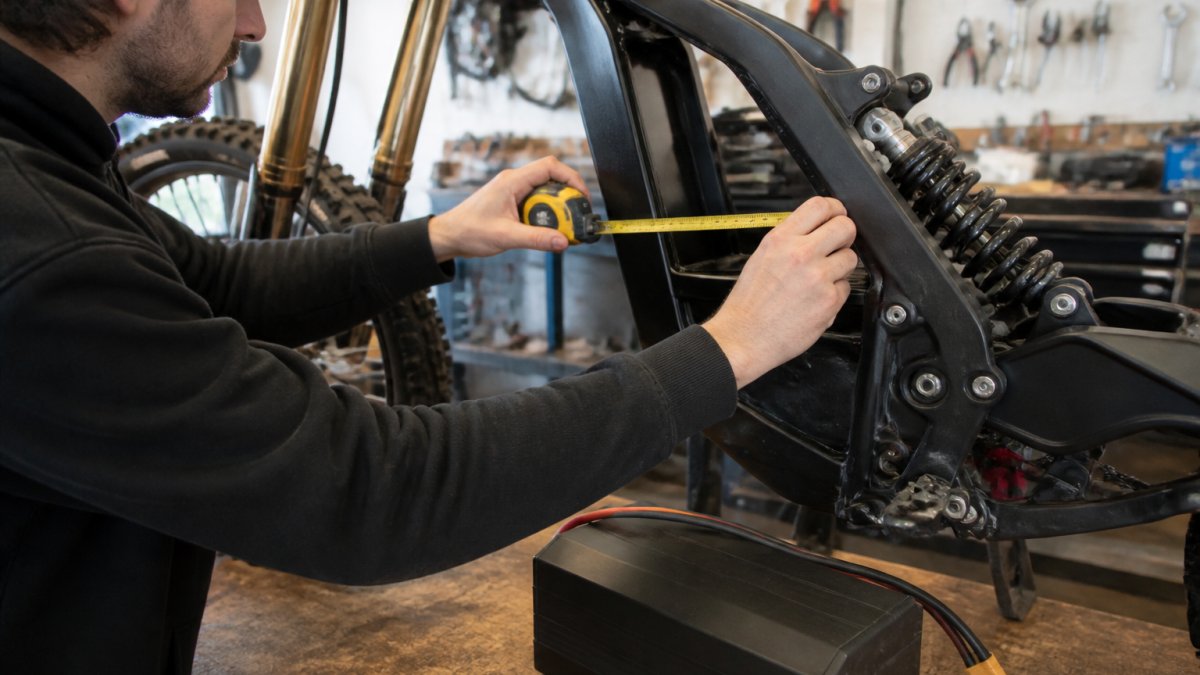
Measure the compartment's length, width, and height with the stock pack removed. Our how to upgrade Sur Ron battery guide walks through fitment step by step before you commit to the swap.
Height is the usual problem. The DHS 88V pack adds about 2cm of height over the stock battery, and most applications require a battery lid extender.
Mounting points and connector type matter too. A pack with the wrong plug needs an adapter or a harness change.
Electric Dirt Bike Battery Range Versus Voltage
Electric dirt bike battery range versus voltage is the trade-off most riders get wrong.
Range comes from watt-hours and how you use them.
The DHS 88V pack lists up to 150km of range depending on riding conditions. That qualifier is doing real work.
Higher voltage can improve efficiency in some setups because the system draws less current for the same power.
If range is your priority, weigh capacity against voltage before you commit. Our breakdown of high-capacity battery benefits and trade-offs covers how to balance the two.
Charging, BMS and Safety Checks Before You Ride
Charging compatibility and the battery management system are where shortcuts cause real damage.
The battery management system, or BMS, protects the pack from overcharge, over-discharge, and cell imbalance.
A charger that matches the pack keeps charge times sane and protects the cells.
Run these checks before the first ride:
- Confirm charger output voltage matches the pack.
- Inspect connectors for correct polarity and fit.
- Check that the BMS powers on and reports normally.
Watch out: charging a high-voltage pack with a mismatched charger can damage the BMS or worse. Match the charger to the pack, every time.
Commissioning Checklist: First Ride After the Swap
A commissioning checklist turns a nervous first ride into a controlled test. Work through it in order, and do not skip steps because the bike starts. A bike that powers on is not the same as a bike that is correctly configured, and the difference shows up under load.
Stage 1: Static Checks Before Power-On
- Fitment and torque. Confirm the pack seats fully, the lid extender seats correctly, and every mounting fastener is torqued to spec.
- Connector inspection. Check polarity, pin condition, and that each connector latches fully. A partially seated connector is a heat source.
- Wiring and fusing. Confirm the main fuse rating matches the pack and controller, and that no harness is pinched against the frame.
- Charger match. Verify the charger's output voltage matches the pack before the first charge.
Stage 2: Power-On and Configuration
- Boot check. Confirm the BMS and controller boot with no fault codes, and that the display reads the correct pack voltage.
- Display behavior. Check that state of charge, voltage, and any temperature readouts behave sensibly. A display calibrated for a lower-voltage pack may misreport percentage even when voltage is correct.
- Controller configuration. Confirm the controller's voltage and current limits are set for the new pack, not left at stock values. This is the step most often skipped.
Stage 3: Controlled First Ride
- Throttle response on a stand. Confirm smooth engagement and clean return before any load.
- Low-speed run. Ride at walking pace and listen for unusual noise or heat.
- Regen check. Confirm regenerative braking engages and feels consistent.
- Thermal check. After a short run, feel the controller and motor for excess heat. Repeat after a longer run.
- Range baseline. Note the state of charge after a known route so you have a reference for future rides.
If anything feels off at any step, stop and diagnose before pushing harder. A five-minute check now saves a costly failure later.
Failure Risks to Watch
- BMS limits. A BMS rated below the pack's current demand will cut power under load or run hot. Confirm its ratings against the pack.
- Fuse and wiring. Undersized fusing or wiring turns a current spike into a fire risk. Match both to the controller's battery current.
- Thermal risk. Heat is the first sign of a mismatch between pack, controller, and motor. Treat a hot controller as a warning, not a quirk.
Get Your 88V Build Fitment-Checked Before You Order
An 88V battery conversion rewards planning and punishes guesswork. The riders who get the most from a swap are the ones who confirm voltage, phase current, and physical fitment before a single part ships.
That is the part we take seriously at RYVOX.
We are an authorized dealer for Arctic Leopard, Yozma, and Ventus. Our team rides these machines, and we would rather talk you out of the wrong part than sell it to you.
Frequently Asked Questions
What performance gains can an 88V battery conversion provide?
An 88V battery conversion raises the voltage ceiling your motor and controller can draw from, which is where extra peak power and stronger acceleration come from. The DHS 88V 40Ah pack is listed at 48.4kW peak and 26.4kW continuous with 550A peak current. The catch is that those numbers only reach the ground if your controller and motor are rated to handle the voltage and current. Gains are real, but they depend on the whole system, not the pack alone.
Can a stock controller handle an 88V battery?
Do not assume it can. A higher-voltage pack only delivers its potential if the controller is rated for that voltage and its phase current matches what the motor can take. Check the controller's rated voltage and battery series range against the pack before ordering. If the controller tops out below 88V, budget for a replacement unit such as the VTB Aetos Pro or EBMX X-9000-V3, and confirm the wiring harness and motor are compatible too.
Will an 88V battery increase range?
Range depends on watt-hours, not voltage alone. Watt-hours come from voltage multiplied by amp-hours, so a pack with more usable capacity can go further, but a more powerful setup also burns energy faster if you ride harder. The DHS 88V 40Ah pack lists up to 150km depending on riding conditions. Rider weight, terrain, throttle habits and tire choice all shift that figure, so treat any range number as a starting estimate.
How do you check whether an 88V battery fits your bike?
Start with the product listing's stated fitment, then measure the battery compartment yourself. The DHS 88V 40Ah pack lists fitment for the Sur-Ron Light Bee and Talaria Sting, adds only 2cm of height over the stock battery, and most applications require a battery lid extender. Confirm your exact model and year, check lid clearance, and verify the connectors and mounting points before you order. Fitment checked against your specific bike is the difference between a bolt-in swap and a return.
Ready to sort out your build? Send us your model, year, and what you are trying to achieve, and we will tell you what actually fits.
