
High-Capacity E-Moto Battery: Benefits and Trade-Offs
Learn how a high-capacity e-moto battery extends range, improves performance, and what trade-offs to consider before upgrading your electric dirt bike.

Table of Contents
- What a High-Capacity E-Moto Battery Does
- E-Moto Battery Range: How Capacity Affects Riding Distance
- Electric Dirt Bike Battery Upgrade: Performance and Efficiency Gains
- E-Moto Battery Compatibility: What You Need to Know Before Installing
- E-Moto Battery Lifespan: Degradation and Long-Term Care
- Weight, Handling, and Real-World Trade-Offs
- Installation Safety and Professional Support
- Frequently Asked Questions
Last Updated: October 18, 2026
What a High-Capacity E-Moto Battery Does
A high-capacity e-moto battery is a lithium-ion power pack with significantly larger energy storage than a stock battery, designed to extend riding range and support higher performance demands on electric dirt bikes.
Upgrading changes the fundamental energy budget of your bike. A stock battery might deliver 1,500Wh of usable capacity; a high-capacity option could double or triple that, translating into longer trail sessions and more aggressive riding without range anxiety.
The battery management system (BMS) inside a high-capacity pack monitors cell voltage, temperature, and discharge current to protect the cells and optimize performance. According to battery technology research from the Department of Energy, lithium-ion systems achieve 150-250 watt-hours per kilogram, making them the standard for high-performance off-road machines.
The decision hinges on what you gain beyond range: how your bike behaves under load, how it ages, and what charging infrastructure you need.
E-Moto Battery Range: How Capacity Affects Riding Distance
The relationship between battery capacity and riding distance is not linear. Consumption depends on terrain, rider weight, throttle usage, speed, tire pressure, and rolling resistance.
Worked Watt-Hour Math for an E-Moto
The cleanest way to judge a high-capacity e-moto battery is to work in watt-hours (Wh) and watt-hours per mile (Wh/mi). A typical electric dirt bike draws roughly 25-50 Wh/mi in moderate trail riding, and 60-100 Wh/mi or more under aggressive throttle, deep sand, or long climbs. These are rules of thumb, but they let you compare packs on equal footing.
Run the numbers on a 2,000Wh pack and a 5,000Wh pack at 40 Wh/mi:
- 2,000Wh ÷ 40 Wh/mi = about 50 miles of moderate trail riding
- 5,000Wh ÷ 40 Wh/mi = about 125 miles under the same conditions
Now push the same packs to 80 Wh/mi with hard throttle and climbing:
- 2,000Wh ÷ 80 Wh/mi = about 25 miles
- 5,000Wh ÷ 80 Wh/mi = about 62 miles
The headline gain looks like 2.5x, but the real-world gain depends on how you ride. In sand, mud, and loose surfaces, the high-capacity pack shines because it sustains full power longer without voltage sag forcing the controller to cut current.
Usable Capacity vs. Nominal Capacity
Usable capacity, the energy you can actually draw from the pack, often differs from total capacity. A 5,000Wh battery might only allow 4,500Wh of safe discharge to protect cell longevity. When evaluating a high-capacity e-moto battery upgrade, confirm the usable capacity on the product page, not just the headline figure.
Conditions That Move the Number
Terrain has an outsized effect on range. Sand, mud, and loose surfaces increase rolling resistance and demand more power. Cold weather reduces range by 10-30%, and the BMS may limit discharge current as a safety measure; a high-capacity battery offsets this penalty with more energy in reserve.
Rider weight and tire pressure matter too. A heavier rider and soft tires both raise Wh/mi. Check tire pressure before every ride; a few PSI of under-inflation can cost measurable range.
A high-capacity e-moto battery does not change the physics of consumption, it just gives you a bigger tank. Match the pack to the terrain and riding style you actually use.
Electric Dirt Bike Battery Upgrade: Performance and Efficiency Gains
Upgrading to a high-capacity e-moto battery changes how your bike delivers power, not just how long it runs. With a larger pack, the controller can sustain higher current output for longer periods without voltage sagging under load.
That means better hill-climbing, faster acceleration, and full power through technical sections without the bike "running out of steam" as the battery depletes.
Efficiency gains are more subtle. A larger battery with more cells in parallel distributes current across more pathways, reducing resistive heating.
The Ventus Ultra Bee Battery at 5,251Wh represents the high end of capacity for compatible platforms. Its 96V nominal voltage and 800A peak discharge current support sustained high-power riding, making it a choice for riders who prioritize performance over all-day cruising.

E-Moto Battery Compatibility: What You Need to Know Before Installing
Compatibility is where most upgrades go wrong. A high-capacity e-moto battery must match your bike's voltage system, controller input, charging infrastructure, and physical mounting space. An incompatible pack can damage the controller, charger, or wiring.
Motor and Controller Matching
The motor and controller form a system. They communicate through voltage and current protocols. A stock 48V system cannot accept a 72V or 96V battery without an aftermarket controller rated for that voltage. The stock controller will fail immediately under the higher voltage stress.
When upgrading to a high-capacity e-moto battery in a higher voltage class, you must also upgrade the controller to match the battery's nominal voltage, peak discharge current, and the motor's power handling. A 3,000W motor paired with a 2,000W controller will not deliver the motor's rated power; the controller becomes the bottleneck.
Confirm controller compatibility on the product page before ordering. RYVOX verifies fitment for each exact model and year before shipping any battery or controller combination. This eliminates the guesswork that catches most riders off guard.
Charging Speed and Infrastructure
A high-capacity e-moto battery requires a charger rated for its voltage and capacity. A stock charger designed for a 2,000Wh pack will take 8-12 hours to charge a 5,000Wh pack, if it works at all; many are current-limited and cannot safely charge larger packs.
Fast chargers come with trade-offs. A 1200W charger can fill a 5,000Wh pack in 4-5 hours instead of 10-12, but your garage outlet must support the power draw without voltage sag. The Ventus Fast Charger delivers 1200W output.

Charging speed also affects longevity. Slower charging (200-500W) generates less heat and extends cycle life; faster charging (1000W+) generates more heat and accelerates degradation slightly.
E-Moto Battery Lifespan: Degradation and Long-Term Care
Lithium-ion cells degrade with each charge cycle. A typical high-capacity e-moto battery retains about 80% of its original capacity after 500-1,000 full charge cycles. At 100 cycles per year, that's 5-10 years of regular use before capacity drops below acceptable levels.
Ventus Ultra Bee Battery — 96V 56Ah →
How Degradation Actually Works
Degradation is not linear. The first 100 cycles show minimal loss. Cycles 200-500 show gradual decline. After 800 cycles, degradation accelerates. Temperature, charging speed, and depth of discharge all influence the rate.
Three mechanisms drive most of the loss:
- Calendar aging. Cells lose capacity simply by sitting, especially at high state of charge and warm temperatures. A pack stored at 100% in a hot garage ages faster than one stored at 50% in a cool space.
- Cycle aging. Each full charge and discharge consumes a small amount of usable capacity. Shallow cycles (20-80%) cost less than full 0-100% cycles.
- Thermal stress. Heat from fast charging, aggressive riding, or a hot environment accelerates chemical breakdown inside the cells.
Charging Habits That Extend Life
Charging to 100% every time accelerates degradation compared to stopping at 80%, and storing above 80% degrades cells faster. Ideal storage is 40-60% state of charge in cool conditions; for winter storage, partially discharge the battery and keep it cool rather than fully charged.
Cold storage slows degradation dramatically: a battery stored at 40°F loses charge much slower than one stored at 70°F.
The BMS protects against overcharging and over-discharge, but it cannot prevent the underlying chemical aging process. A high-capacity e-moto battery will eventually need replacement.
Compatibility Checklist Before You Install
Lifespan starts at installation. A pack that is mismatched to the controller, charger, or wiring will run hot and age fast. Before installing, confirm each item on this list against the product page and your bike's documentation:
- Voltage class. The pack's nominal voltage must match the controller and motor rating. A stock 48V system cannot accept a 72V or 96V battery without an aftermarket controller rated for that voltage.
- Peak discharge current. Connectors, wiring, and the controller must be rated for the pack's peak discharge current. A connector rated for 200A cannot safely handle 800A discharge without overheating.
- BMS communication. Confirm the BMS protocol matches what the controller expects, or that the pack runs in a standalone mode the controller supports.
- Charger match. The charger must be rated for the pack's voltage and capacity. A stock charger designed for a 2,000Wh pack will take 8-12 hours to charge a 5,000Wh pack, if it works at all.
- Mounting space and hardware. The pack must fit the frame with secure, vibration-isolated brackets. A loose battery can shift during riding, stressing connectors and potentially causing internal short circuits.
- Wiring gauge and routing. High-current discharge cables need proper gauge and shielding to prevent voltage drop and electromagnetic interference.
Total Cost of Ownership
Plan for replacement as part of your long-term ownership budget. Track your cycles and your Wh/mi so you know when capacity has dropped enough to justify a replacement rather than guessing from feel.
A high-capacity e-moto battery rewards riders who charge gently, store cool, and confirm compatibility up front. The same pack that lasts a decade under good habits can fade in half that time under heat, full-charge storage, and mismatched hardware.
Weight, Handling, and Real-World Trade-Offs
A high-capacity e-moto battery weighs more than a stock pack. The Ventus Ultra Bee at 5,251Wh weighs 25 kilograms, roughly 55 pounds.
Weight distribution matters. A battery mounted low and centered improves handling; one mounted high or to the rear destabilizes the bike and increases effort on technical terrain. Check the mounting location on your specific model before upgrading.
The weight penalty is noticeable but manageable on most models. Acceleration feels slightly slower, but extended range and sustained power delivery offset the sluggishness for most use cases.
Handling degradation is most apparent in tight switchbacks and when lifting the bike by hand. A 25-kilogram battery adds real effort to repositioning it on the trail or loading it into a truck.
Installation Safety and Professional Support
Installing a high-capacity e-moto battery is not a casual weekend project.
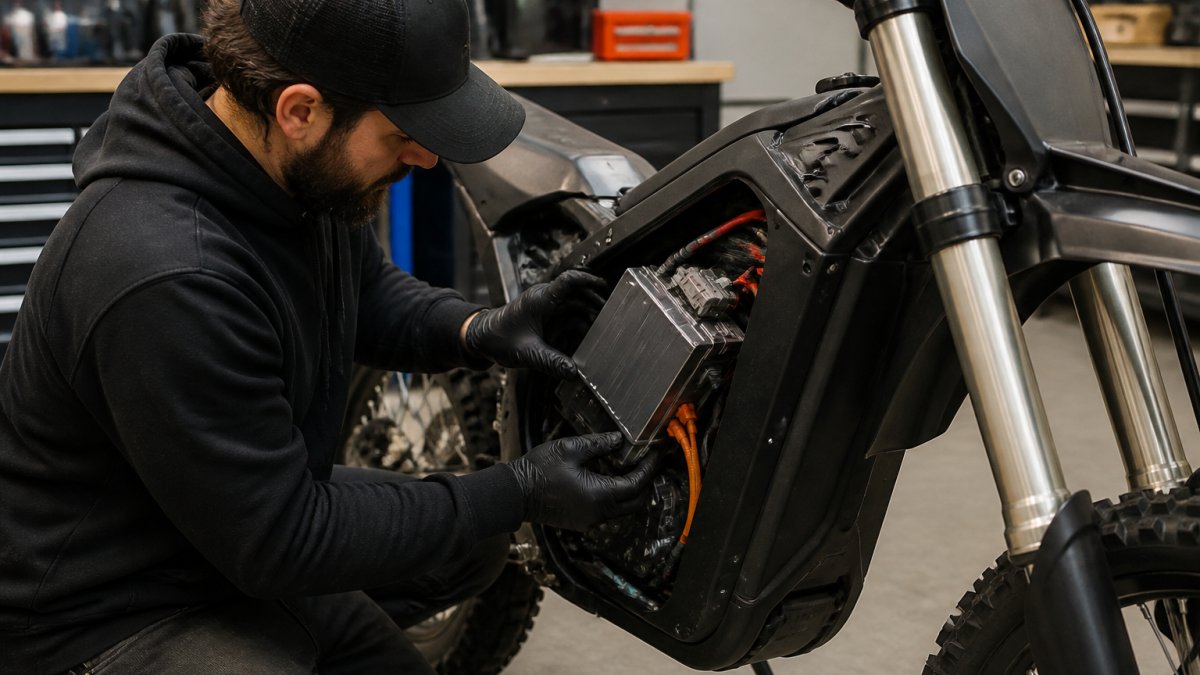
The first critical step is disconnecting the stock battery and controller completely.
Cable routing must follow the new battery's specifications.
Mounting must be secure and vibration-isolated. A loose battery can shift during riding, stressing connectors and potentially causing internal short circuits.
RYVOX handles battery installation as a flat-rate service for compatible models.
If you're installing the battery yourself, confirm every connection against the wiring diagram for your specific bike model.
Upgrading to a high-capacity e-moto battery is a legitimate performance move for riders who want extended range and sustained power delivery.
When you're ready to upgrade, RYVOX verifies fitment for your specific machine and handles installation with the precision these systems demand.
Frequently Asked Questions
How does a high-capacity e-moto battery affect my riding range?
A high-capacity battery stores more watt-hours of energy, directly extending your riding distance on a single charge. For example, upgrading from a 51Ah to a 56Ah pack increases total usable capacity, which translates to longer trail sessions before needing to recharge. Real-world range depends on terrain, rider weight, speed, and tire pressure, but the capacity increase typically adds 20-40% more distance under the same riding conditions.
What are the drawbacks of installing a larger e-moto battery?
Larger batteries add weight to your e-moto, affecting handling and acceleration. They also require longer charging times and may demand a high-output charger to minimize downtime. Additionally, a larger pack can increase strain on your motor, controller, and drivetrain if those components aren't matched to the battery's discharge capabilities. Battery degradation accelerates with larger packs under aggressive riding, potentially shortening lifespan.
Will a high-capacity battery make my e-moto faster?
Capacity alone does not increase top speed. Speed is determined by motor power and controller settings, not battery size. However, a high-capacity battery can deliver consistent power delivery throughout a longer ride, maintaining performance when a smaller pack would begin to sag. If your original battery was undersized for your motor and riding style, upgrading may feel more responsive, but this is about matching capacity to demand, not gaining speed.
How do I know if a high-capacity battery is compatible with my e-moto?
Compatibility depends on voltage, connector type, mounting space, and your motor-controller pairing. Before ordering, verify the battery's voltage matches your system and that the physical pack fits your frame. Check with the manufacturer or a shop like RYVOX that verifies fitment against your exact model and year before shipping. Installing an incompatible battery risks damaging your controller, motor, or charger, and may void warranties.