
Best Performance Upgrades for Surron Light Bee
The best performance upgrades for the Surron Light Bee, ranked by rider type, terrain, and compatibility so you buy the right part once.

Table of Contents
- How to Choose Surron Light Bee Upgrades That Actually Fit
- Upgrade Priorities by Rider Type and Terrain
- Surron Light Bee Controller Upgrade: The Biggest Power Gain
- Surron Light Bee Battery Upgrade: Range, Heat, and Reliability Trade-Offs
- Surron Light Bee Suspension Upgrade: Forks, Shocks, and Swingarms
- Surron Light Bee Brake Upgrade: Stopping Power and Safety
- Wheels, Drivetrain, and Contact Points That Change How the Bike Feels
- Conclusion
- Frequently Asked Questions
Last Updated: October 20, 2026
How to Choose Surron Light Bee Upgrades That Actually Fit
The best performance upgrades for Surron Light Bee owners start with fitment, not horsepower. RYVOX checks every order against your exact model and year before it ships, because the most common failure in this platform is a part that bolts on but does not belong. The Sur-Ron Light Bee has run through multiple model years and configurations, and a controller harness, fork axle, or rear shock that suits one build can miss another entirely.
Here is the short version: buy in the order your riding exposes weakness. Power first if you ride open terrain, suspension and brakes first if you ride technical trails. Everything else follows.
Below, we break down each upgrade category by what it changes, who it suits, and what supporting parts you need to buy alongside it.
Upgrade Priorities by Rider Type and Terrain
Match the upgrade to the riding, not to the spec sheet. A trail rider who bolts on a high-output controller before touching brakes has built a faster bike that stops the same as before.
| Rider Type | First Upgrade | Second Upgrade | Skip Until Later |
|---|---|---|---|
| Trail and technical singletrack | Suspension | Brakes | Controller |
| Open dirt, fire roads, hill climbs | Controller | Drivetrain | Forks |
| Supermoto and hard-surface builds | Wheels and tires | Brakes | Swingarm |
| New owners, stock bike | Belt and contact points | Suspension | Controller |
The pattern holds across most builds. Riders who upgrade in this order report fewer supporting-part surprises, because each step is chosen to handle the load the previous step created. Riders who go power-first often end up buying brakes and a rear shock anyway, just later and with more downtime.
Surron Light Bee Controller Upgrade: The Biggest Power Gain
A controller swap is the single largest change you can make to how a Sur-Ron Light Bee feels. It rewrites throttle response, power delivery, and top-end pull in one part, and it is the upgrade most riders ask about first.
Two options in our catalog cover the Sur-Ron Light Bee:
- EBMX X-9000-V3 Controller rates 50kW continuous with 1000A phase current and 1600A burst, runs 48V to 93V, and carries an IP67 case. It ships with a display, thumb throttle, and Bluetooth module, but the bike wiring harness and mounting kit are sold separately.
- VTB Aetos Pro Controller delivers up to 76kW with 1200A phase current, tunes through the Ventus mobile app, and lists the Sur-Ron Light Bee as a supported platform.
Both units are programmable, and both change the character of the bike more than any other single part. Budget for the harness and mounting hardware, not just the controller.


Surron Light Bee Battery Upgrade: Range, Heat, and Reliability Trade-Offs
Battery decisions are where most builds go wrong, because the pack has to feed the controller you just installed. A higher-output controller pulls harder on the pack, which raises heat and shortens range per charge. That is a trade-off, not a defect.
The practical rule: match your battery's voltage and series count to the controller's working range before you buy either. The EBMX X-9000-V3 runs 48V to 93V, and the VTB Aetos Pro accepts 12S to 22S packs (breakdown @ 112V).
Heat matters more than peak numbers on long climbs. Controllers with water-cooling options and larger thermal mass hold output longer before pulling back. If your rides are short and punchy, thermal headroom matters less. If you climb for minutes at a time, it matters most.
Surron Light Bee Suspension Upgrade: Forks, Shocks, and Swingarms
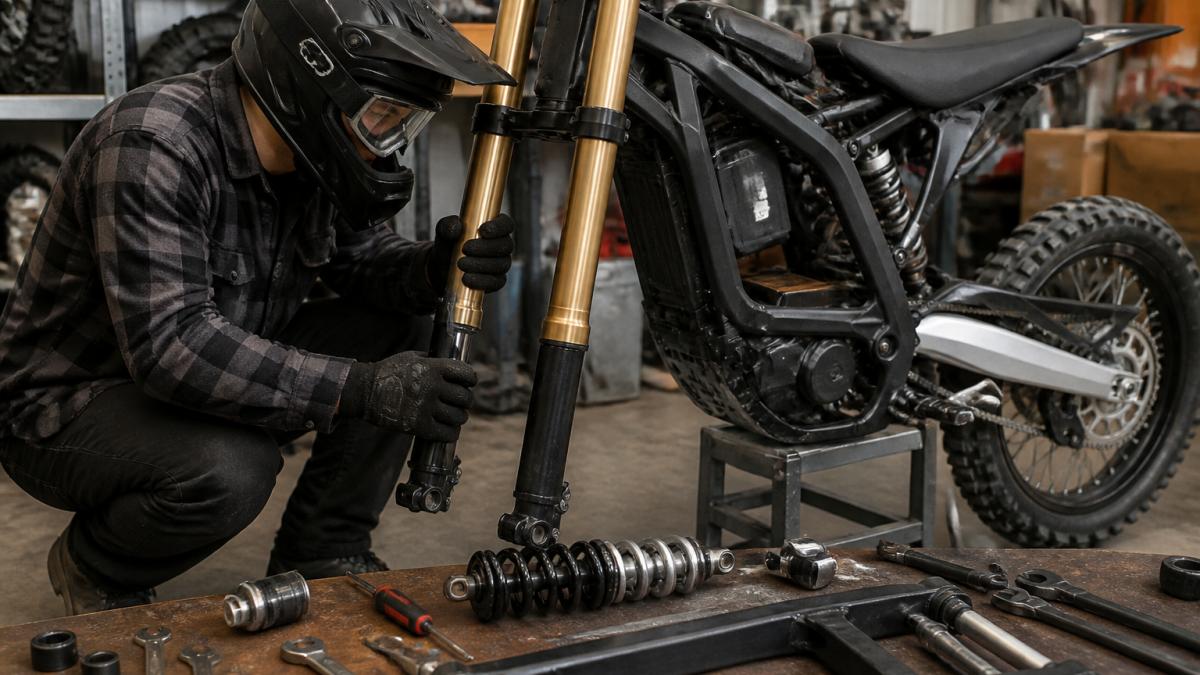
Suspension is the upgrade trail riders feel immediately, and the one that most changes confidence on rough ground. Three paths exist, and they differ mainly in how much adjustability you want.
- Warp 9 FastAce Suspension Bundle pairs a FastAce AHX12RVP fork with custom valving, a 60 lb spring rate, and Motul synthetic oil, tuned for riders in the 175-220 lb range. It includes brake brackets for 203mm and 220mm rotors and fits the Light Bee X and S.
- EXT Ferro EMX Fork uses a hybrid air spring with independent high- and low-speed compression plus rebound adjustment, 205mm of travel, and fits Light Bee X and S across all model years with a boost rotor spacer.
- Sirris F43 CMX Front Fork runs a 43mm chassis with 220mm travel and tool-free compression adjusters. It fits the Light Bee X from 2019 through 2025, but requires a 220mm rotor upgrade and a 4-bolt direct-mount stem.
On the rear, the EBMX Extended Swingarm adds 60mm of wheelbase and 220mm of travel when paired with the EBMX YSS shock and linkage. EBMX states plainly that OEM-style shocks will not perform well with the longer arm, because the extended lever puts more force into the shock. Buy the shock with the swingarm or not at all.

Surron Light Bee Brake Upgrade: Stopping Power and Safety
Brakes are the upgrade riders skip and later regret. More power and more suspension travel both raise the speed you carry into a corner, and stock stopping power does not scale with either. The Light Bee X ships with a 200mm front rotor, and several fork upgrades are built around a 220mm rotor, which means the brake upgrade is not optional once you change the front end.
What actually changes stopping power
Three variables matter, in this order:
- Rotor diameter and thickness. A larger rotor increases leverage at the caliper and gives heat somewhere to go on long descents. The Sirris F43 fork requires a 220mm rotor; the Warp 9 FastAce bundle includes brackets for both 203mm and 220mm rotors. Fit the rotor the fork was designed around rather than shimming a smaller one.
- Pad compound. Sintered metallic pads bite harder and shed heat better but wear rotors faster and can be noisy. Organic or resin pads are quieter and easier on rotors but fade sooner under repeated hard stops. For long descents, a cooler-running compound preserves lever feel; for short technical sections, a more aggressive bite shortens stopping distance.
- Hydraulic system condition. Fresh fluid, a proper bleed, and clean caliper pistons do more for lever feel than most hardware swaps. A spongy lever is usually air in the line, not a weak caliper.
Supporting parts you need alongside the brake upgrade
- Rotor and bracket. Match the bracket to the fork's caliper mount and the rotor's diameter. Mixing a 203mm bracket with a 220mm rotor, or the reverse, misaligns the caliper and pads.
- Brake line length. A taller fork or a different bar height can leave the stock line short. Measure before ordering.
- Lever and master cylinder. If you change bar diameter or add a thumb throttle, confirm the lever clamp fits the new bar.
- Mounting bolts. Use the hardware specified for the caliper and bracket; mismatched bolt length or thread pitch is a common install failure.
Installation difficulty and dependencies
A pad swap is a bench-level job with basic hand tools. A rotor and bracket swap is a moderate job that requires torqueing caliper bolts to spec and re-bleeding if the line is opened. A full caliper or master cylinder change is the most involved and should be followed by a complete bleed and a lever-feel check before the first ride. If you are unsure, the shop's flat-rate service and hourly labor can handle the install and bleed.
What to skip until later
If you ride mostly flat, low-speed terrain and have not changed the fork, a pad upgrade and a fresh bleed are usually enough. Save the rotor and caliper change for when you add suspension travel or a controller, because that is when the stock system becomes the limiting part.
Wheels, Drivetrain, and Contact Points That Change How the Bike Feels
Wheels and drivetrain parts do not add power, but they change how the bike puts power down and how it feels underneath you. This is where a build starts to feel finished.
The Warp 9 19/16 Wheel Set runs a 19 x 1.60 front and 16 x 1.85 rear, arrives mounted, and offers a bare configuration or a 220mm rotor and sprocket package with your choice of sprocket size. The Warp 9 17" Supermoto Wheel Set runs 17 x 2.15 front and 17 x 2.50 rear for hard-surface builds.
On the drivetrain, the Gates GT4 Power Grip Belt replaces the stock primary belt with a 16mm high-torque synchronous design. The Warp 9 Warp Drive converts the belt primary to a 420 chain drive with dampened sprockets and a KMC O-ring chain, keeping the OEM final drive ratio.
Contact points round out the build. Foot pegs, bars, and a fender or mud guard change control and durability for very little money, and they are the parts riders notice on every ride.
Conclusion
The hardest part of building a Sur-Ron Light Bee is not choosing parts. It is knowing which parts belong on your exact bike, in what order, and with what supporting hardware. Get that sequence wrong and you buy twice.
At RYVOX, we check fitment against your model and year before anything ships, and we stock genuine parts from brands including EBMX, Warp 9, EXT, Sirris, and Ventus. We are an authorized dealer for Arctic Leopard, Yozma, and Ventus, and our in-house service team handles installs and PDI at the shop.
Text the shop with your bike's model year and the riding you actually do, and we will tell you what to buy first, what to pair it with, and what to leave alone for now.
Frequently Asked Questions
What are the best performance upgrades for a Surron Light Bee?
Start with the parts that change how the bike delivers power and how it stops. A controller upgrade such as the EBMX X-9000-V3 or VTB Aetos Pro unlocks more output and finer throttle tuning. Then add a brake upgrade with a larger rotor and matching brackets, and a suspension upgrade sized to your weight. Wheels, a Gates GT4 belt, and a Warp 9 Warp Drive chain conversion round out the build once the core systems are sorted.
Which Surron Light Bee upgrade should I do first?
Match the first part to your riding. Trail riders get the most from suspension and brakes because control and stopping matter more than peak output. Riders chasing acceleration should do the controller first, since it wakes up the stock motor without a motor swap. Commuters and supermoto builds benefit from wheels and tires before power. Whatever you pick, confirm fitment against your exact model year before ordering.
Does a controller upgrade increase Surron Light Bee power?
Yes. A controller upgrade is the single largest power change you can make on a Light Bee. The EBMX X-9000-V3 is rated at 50kW output with 1000A phase current and 1600A burst, and it is preloaded with tunes for 30+ motors. The VTB Aetos Pro delivers up to 76kW with app-based tuning of throttle response, ride profiles, and regenerative braking. Both need the correct bike-specific harness, which is often sold separately.
How do I check whether a performance part fits my Light Bee model and year?
Check the product page for an explicit fitment list, then confirm your exact model and year against it. Some parts carry conditions: the Sirris F43 fork needs a 220mm front rotor and a 4-bolt direct-mount stem on a Light Bee X, and the EBMX Extended Swingarm is not compatible with the Sirris R38 shock. Never assume a part fits because it is listed for the Light Bee generally.
Do upgraded brakes make a Surron Light Bee safer to ride?
They do, because more power is only useful if you can shed speed predictably. A brake upgrade with a larger rotor, a caliper adapter, and matched pads shortens stopping distance and reduces fade on long descents. If you move to a fork sized for a 220mm rotor, the rotor upgrade becomes mandatory rather than optional. Pair the brakes with fresh tires so the contact patch keeps up with the stopping force.