
Best Sur Ron Aftermarket Controller Review 2026
Best sur ron aftermarket controller review: Compare the best Sur Ron aftermarket controllers for 2026. Real specs, pricing, fitment notes, and tuning tips.

Table of Contents
- Quick Comparison: Sur Ron Aftermarket Controllers at a Glance
- EBMX X-9000-V3 Controller Kit: The Complete Race Ecosystem
- VTB Aetos Pro, Max, and Ultra: Ventus Controllers Compared
- Sur Ron Battery Compatibility for Aftermarket Controllers
- Sur Ron Controller Tuning Guide: Firmware, Apps, and Ride Modes
- Installation, Wiring Harnesses, and Troubleshooting
- What Most Reviews Skip: Maintenance, Motor Life, and Legal Reality
- Frequently Asked Questions
Last Updated: September 16, 2026
Quick Comparison: Sur Ron Aftermarket Controllers at a Glance
Anyone shopping for the best Sur Ron aftermarket controller review has noticed what we have at RYVOX: the market splits into two camps, and the marketing rarely tells you which fits your bike. A controller sits between your battery and motor, converting throttle input into phase and battery current. Get it wrong and you either cook your motor or waste half your bike's potential.
| Controller | Price | Rated Voltage | Phase Current | Peak Output | Best For |
|---|---|---|---|---|---|
| EBMX X-9000-V3 | $1,279 | 120V | 1000A continuous | 50 kW | Complete race ecosystem, plug-and-play kit |
| VTB Aetos Pro | $1,099 | 72V/81V | 1200A | 76 kW | 72V/81V builds wanting max headroom |
| VTB Aetos Max | $1,199 | 96V | 960A | 76 kW | 96V packs, balanced power |
| VTB Aetos Ultra | $1,399 | 118V | 760A | 76 kW | 100V+ high-voltage race builds |
EBMX X-9000-V3 Controller Kit: The Complete Race Ecosystem
The X-9000-V3 is our most-recommended controller for riders who want one box, one install, and no missing parts. It uses a re-engineered power stage with 30 120V Infineon MOSFETs, a multilayer PCB, and CNC copper busbars. Continuous output is 50 kW with 1000A phase current and 1600A burst.

Power Specs and Thermal Design
Heat kills controllers, and this is where the X-9000-V3 separates itself. The CNC alloy case is IP67-rated and the kit includes an air-cooled heat sink; a water-cooling option exists for race-level endurance.
What's in the Box and Who It Fits
This justifies the price gap: the kit ships with the controller, plug-and-play harness and mount kit, air-cooled heat sink, SW102T color display, thumb throttle, Bluetooth module, and 1-2 harness. Nothing else to buy.
- Custom EBMX VESC firmware with field-oriented control
- Six customizable power levels covering race and street modes
- Over 15 load-and-go battery profiles for plug-and-play setups
- Preloaded tunes for 30+ motors
- OTA firmware updates
- valid warranty support
VTB Aetos Pro, Max, and Ultra: Ventus Controllers Compared
Ventus takes a different route. All three Aetos controllers share 76 kW peak output but differ in rated voltage and battery series support. Picking the wrong one is the most common ordering error we see, and an expensive one.
Aetos Pro ($1,099): The 72V/81V Sweet Spot
The Aetos Pro is the entry point and best seller. Rated at 72V (20S) and 81V (22S) with 112V breakdown, it runs 1200A phase current tested to 1600A and supports 12S-22S. Throttle response stays progressive at low output, then turns explosive.
Aetos Max ($1,199) and Aetos Ultra ($1,399): Higher Voltage, More Headroom
The Aetos Max steps up to 96V rated, 138V breakdown, 960A phase current tested to 1300A, and 12S-26S support. The Aetos Ultra goes further: 118V rated, 170V breakdown, 760A phase current tested to 1000A, and 12S-32S.
Sur Ron Battery Compatibility for Aftermarket Controllers
Battery compatibility is the most common reason a controller upgrade goes wrong, and it comes down to four numbers: rated voltage, battery series (S count), breakdown voltage, and continuous discharge current. Match all four or don't buy.
Here's how the field breaks down by pack type.
Voltage Sag, BMS Limits, and Why Your Controller Throttles
Voltage sag is the variable most reviews skip. A pack reading 84V at rest can drop well below that under hard acceleration, and the controller sees the sagging voltage, not the resting number. As voltage drops under load, the controller pulls more current to make the same power, heating both controller and pack.
Matching Battery, Controller, and Motor as a System
The controller is the middle of a three-part system, and upgrading only the middle is the most common mistake. A stock motor with a 1000A phase current controller hits thermal limits long before the controller does; a high-output pack with a stock controller wastes the pack; a high-voltage controller with a low-voltage pack is a safety risk.
Sur Ron Controller Tuning Guide: Firmware, Apps, and Ride Modes
A tuning guide that ignores firmware lifecycle is only half a guide. Both platforms push over-the-air updates, and cadence matters as much as the initial tune. A controller with quarterly firmware and new motor profiles beats one with a slightly better spec sheet and no update history.
EBMX X-9000-V3 CONTROLLER KIT →
Field-Oriented Control and Why It Feels Different
Field-oriented control separates phase current into torque-producing and flux-producing components, which is why FOC controllers feel smoother than square-wave designs. The X-9000-V3 runs custom EBMX VESC firmware with Field-Oriented Control (FOC); Ventus runs its own tuning stack via the mobile app. Both are FOC-based, so the difference is tuning philosophy, not control method.
The Parameters You Actually Adjust
Both platforms expose roughly the same core parameters, just under different names:
- Battery current limit, caps how much the pack can deliver. Set this to your BMS continuous rating, not above it.
- Phase current limit, caps torque. This is the number that heats your motor. Raising it past the motor's design limit shortens motor life.
- Throttle ramp rate, how fast power builds when you twist. Lower is smoother, higher is snappier.
- Regen strength, how much braking force the motor provides during deceleration.
- Speed and power limits per profile, the ceiling for each ride mode.
Regenerative Braking Setup
Regenerative braking recovers energy during deceleration and adds drag that mimics engine braking. Both platforms expose it graphically and let you set custom ride profiles. Start conservative: too much regen on a loose surface unsettles the rear end, and aggressive regen on a low state-of-charge pack can push voltage spikes into the BMS.
Firmware Updates and Long-Term Support
This is the part promotional reviews skip. Firmware support is the first thing to check before buying, a controller with no update path falls behind on motor compatibility and bug fixes.
Motor Longevity: The Trade-Off Nobody Prices In
Pushing a stock motor past its design current shortens its life, and higher phase current figures don't change that. The controller delivers more current than the motor can dissipate as heat, and the motor loses every time. If chasing peak power, budget for a motor upgrade alongside the controller, not after it fails.
Installation, Wiring Harnesses, and Troubleshooting
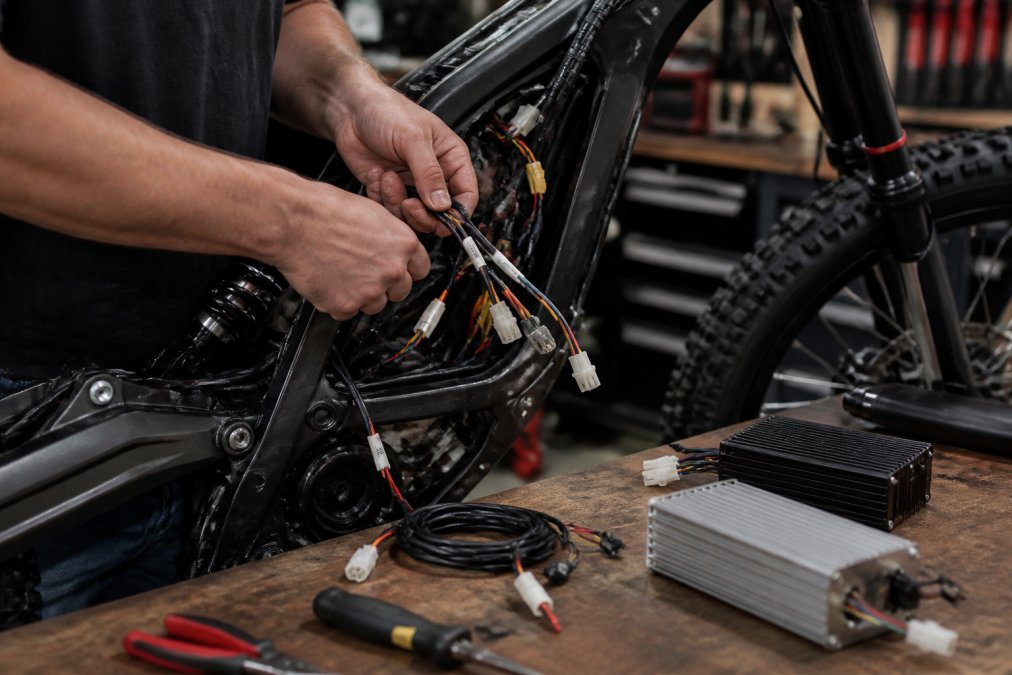
Three troubleshooting errors account for most failed installs:
- Wrong harness version. The V3 X-9000 harness is not compatible with V1 or V2 controllers. The Ultra Bee V3 harness and brackets are likewise not compatible with V2 or V1.
- Unsupported stock motors. The Talaria XXX and 79 Bike Pro stock motors require upgrades before either Ventus controller will work.
- Skipped fitment verification. A 2023 Light Bee and a 2025 Light Bee don't always share the same connector layout. Confirm year and model before ordering.
What Most Reviews Skip: Maintenance, Motor Life, and Legal Reality
Long-term ownership is where promotional content goes quiet. Firmware support is the first thing to check: the X-9000-V3 updates over the air and expands compatibility, while Ventus commits to future updates adding Wheelie Assist, Anti-Rollover Support, G-Force Tracking, and High-Precision Electronic Fall Detection. Both are actively maintained, which matters more than any spec sheet.
Frequently Asked Questions
What is the best controller for a Sur Ron?
It depends on your battery and goals. For a complete kit with everything included, the EBMX X-9000-V3 at $1,279 offers 50kW continuous output, 1000A phase current, 1600A burst, IP67 waterproofing, and a two-year warranty. For high-voltage builds, the VTB Aetos Ultra at $1,399 delivers up to 76kW but requires a 100V+ battery. The VTB Aetos Pro at $1,099 suits 72V/81V setups with 1200A phase current. Match voltage first, then power.
Is a controller upgrade compatible with a stock Sur Ron battery?
Some are, with limits. The EBMX X-9000-V3 works with stock Sur Ron batteries and ships with over 15 plug-and-play battery profiles. The VTB Aetos Pro runs 12S-22S, which covers common stock configurations. The VTB Aetos Ultra needs a 100V+ battery and is not the right pick for a stock pack. Always confirm your battery's voltage and series count before ordering.
Do I need a new motor if I install an aftermarket controller?
Not always. The EBMX X-9000-V3 ships preloaded with tunes for 30+ motors, including the OEM Sur Ron Light Bee and Ultra Bee motors. The VTB Aetos Pro and Max, however, are not compatible with the Talaria XXX stock motor or the 79 Bike Pro stock motor, both of which require an aftermarket upgrade. Check your specific motor against the controller's compatibility list before buying, or ask for fitment verification.
How does a new controller affect Sur Ron top speed and torque?
A controller changes how much phase current and battery current reach the motor, which directly shapes acceleration and throttle response. The EBMX X-9000-V3 pushes 1000A continuous phase current and 1600A burst, with six customizable power levels split between race and street modes. The VTB Aetos Pro runs 1200A phase current tested to 1600A. Real top speed still depends on your battery voltage, gearing, and motor, so treat the controller as one part of the power delivery chain.
What are the legal and insurance implications of a controller upgrade?
An aftermarket controller can push a Sur Ron past the speed and wattage limits many states apply to electric two-wheelers and off-road vehicles, which can change whether it is legal on public roads or trails. Check your state's classification rules before riding on public land. For insurance, tell your provider about the modification, since an undeclared performance part can complicate a claim. Keep receipts and documentation for any controller you install.