
How to Upgrade Your Sur Ron Battery: A 2026 Guide
Learn how to upgrade your Sur Ron battery with our step-by-step guide. Compare voltage options, tools, and controller requirements. Start your build today.

Table of Contents
- Why Upgrade Your Sur Ron Battery?
- Sur Ron 72V Battery Conversion vs. 88V Options
- Sur Ron Controller Upgrade Requirements
- Sur Ron Battery Installation Tools and Safety Gear
- Step-by-Step Battery Upgrade Process
- Battery Health, Degradation, and Legal Considerations
- Conclusion
- Frequently Asked Questions
Last Updated: September 14, 2026
Why Upgrade Your Sur Ron Battery?
The stock Sur Ron Light Bee battery is the single biggest bottleneck in the entire machine. Riders who learn how to upgrade sur ron battery systems quickly discover that the motor and frame can handle far more than the factory pack delivers, and unlocking that headroom changes the bike completely. At RYVOX, we see this constantly: riders spend money on suspension and tires before realizing the real limit sits in the battery tray.
Stock packs run at 60V and sag hard under sustained load. A higher-voltage pack raises available power, reduces voltage sag, and extends range in one move. That's the core reason most performance builds start here.
Sur Ron 72V Battery Conversion vs. 88V Options
A Sur Ron 72V battery conversion is the most common first step, but 88V packs now dominate serious builds. The 72V route is cheaper and gentler on stock controllers; 88V delivers noticeably more top speed, acceleration, and torque, provided your controller and wiring can handle it.
Voltage is electrical pressure. Amp-hours (Ah) measure capacity, roughly how long the pack lasts. Watt-hours (Wh) combine both and represent total energy. A 72V 40Ah pack stores about 2,880Wh; an 88V 40Ah pack stores about 3,520Wh.

| Option | Voltage | Typical Use | Trade-off |
|---|---|---|---|
| Stock | 60V | Commuting, light trail | Voltage sag, limited range |
| 72V conversion | 72V | Trail riding, mild performance | Modest power gain |
| 88V upgrade | 88V | Performance and supermoto builds | Needs controller and harness support |
Range, Speed, and Torque: What Changes
Raising voltage increases top speed and acceleration because the motor spins faster for the same throttle input. Torque gains come from higher current delivery, which is why discharge rate matters as much as voltage. Range extension depends on watt-hours and riding style, not voltage alone. A pack with more energy and less sag holds its power deeper into the ride.
Sur Ron Controller Upgrade Requirements
Your controller is the gatekeeper. A higher-voltage battery will not deliver its potential if the controller caps current or cannot accept the input voltage. Most riders upgrading to 88V also need a controller rated for that voltage and a matching harness. The problem is that most battery listings never tell you which controller to pair with which pack, so riders guess.
Controller Pairing by Voltage and Model
Stock Sur Ron Light Bee controllers are typically rated for 60V nominal input. They will often tolerate a 72V pack because the fully charged voltage of a 72V nominal pack (around 84V for a 20S lithium-ion configuration) sits close to the controller's component ceiling, but sustained operation at that input stresses the MOSFETs and capacitors. An 88V nominal pack charges to roughly 100.8V (24S), which exceeds what a stock controller can safely accept (Battery University).
A practical pairing guide looks like this:
| Battery Nominal Voltage | Fully Charged Voltage (approx.) | Controller Requirement |
|---|---|---|
| 60V (stock) | 67.2V (16S) | Stock controller |
| 72V | 84V (20S) | Stock controller may work; aftermarket 72V-rated controller recommended |
| 88V | 100.8V (24S) | Aftermarket controller rated for 24S input (e.g., EBMX X-9000, BAC4000/BAC8000, or equivalent) |
Check the controller's maximum input voltage spec, not just its nominal rating. A controller labeled "72V" may have a 90V absolute maximum, which gives you headroom for a fully charged 72V pack but not for an 88V pack.
Discharge Rate and Peak Current Limits
Discharge rate, expressed as a C-rating, tells you how fast a pack can safely release energy. A 15C pack on a 40Ah battery supports roughly 600A continuous, which is far more than most controllers draw (Battery University). The controller's peak current limit is usually the binding constraint, not the pack's C-rating. If the controller's peak current limit sits below what the pack can supply, you leave performance on the table. Match the two deliberately: a pack with a high C-rating paired to a controller with a low current limit wastes the pack's capability, while a low-C pack paired to a high-current controller risks overheating the cells.
Firmware Updates and Voltage Sag
Many modern aftermarket controllers accept firmware updates that adjust voltage cutoffs and current maps for your specific pack. Without the right firmware, a controller may read a higher-voltage pack as a fault or throttle output early. Voltage sag, the dip in voltage under hard load, is reduced by quality cells and a healthy BMS, so the controller sees steadier input. A pack that sags from 84V to 70V under load will trigger low-voltage cutoff sooner than a pack that sags only to 78V, even if both start fully charged.
Sur Ron Battery Installation Tools and Safety Gear
High-voltage work is not a bare-hands job. Before you touch the pack, gather insulated tools, a torque wrench, safety glasses, and insulated gloves. A multimeter lets you verify state of charge and confirm the pack is at a safe voltage before connecting anything.
Connector Types: QS8 and Anti-Spark
Modern high-power packs use QS8 connectors, which handle high current with a larger contact surface than stock plugs. Anti-spark connectors prevent the arc that jumps when you connect a live high-voltage pack, protecting both the connector and your controller. If your bike uses the older dual-connector setup, a QS8 power harness converts it to a single high-power connection.

| Part | Purpose | RYVOX Price |
|---|---|---|
| DHS 88V 40Ah Battery (RS50 cells) | High-voltage pack, 15C discharge, ~150km range | $2,500.00 |
| QS8 Power Harness for Surron LBX | Converts bike to QS8 battery connection | $82.00 |
| OEM Battery Power Cable (2024) | Single-connection cable for 2024 models | $98.00 |
| OEM Battery Power Cables (2019-2023) | Dual-connector cables for older models | $91.00 |
Step-by-Step Battery Upgrade Process
Total time: 60-90 minutes. Difficulty: Intermediate.

- Power down and disconnect. Turn off the bike, disconnect the main breaker, and let the controller discharge.
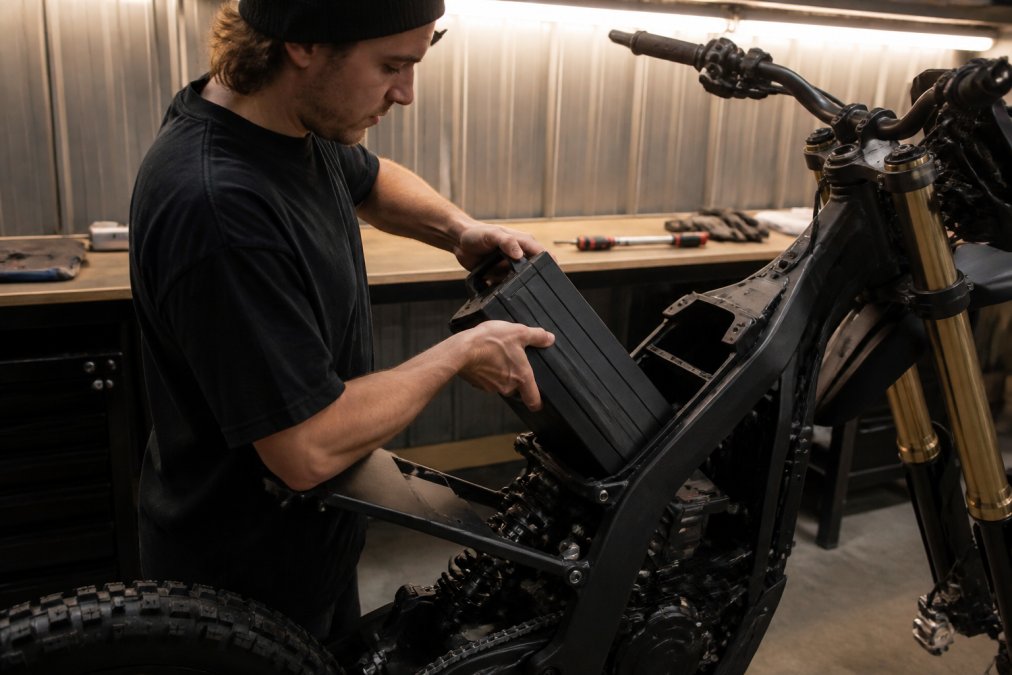
- Remove the stock pack. Unbolt the battery tray and lift the pack out, noting cable routing.
- Inspect connectors. Check whether your bike uses the dual-connector or single-connection cable and confirm your new harness matches.
- Install the new harness. Route the QS8 harness or OEM cable along the original path and secure it away from moving parts.
- Seat the new battery. Lower the pack into the tray and torque the mounting bolts to spec.
- Connect and verify. Plug in the anti-spark connector, then check voltage with a multimeter before powering the controller.
- Test at low load. Ride gently for the first few minutes and watch for faults or unusual heat.
Battery Health, Degradation, and Legal Considerations
Lithium-ion packs lose capacity over time, and cycle life depends on how you charge and discharge them. Charging with a smart charger at moderate current, avoiding full discharges, and storing at partial charge all extend pack life. Thermal management matters too; heat is the enemy of long-term health, and a quality BMS protects against thermal runaway by cutting current before cells overheat.
What Actually Causes Degradation
Capacity loss comes from three main mechanisms: calendar aging (time spent at high state of charge), cycle aging (charge/discharge cycles), and thermal stress.
Legal and Insurance Implications of a Voltage Upgrade
Conclusion
Frequently Asked Questions
Can you upgrade the battery on a Sur Ron?
Yes, you can upgrade the Sur Ron battery. The Light Bee X accepts higher-voltage packs, but you must match the battery to your controller and wiring. Stock 60V systems need a controller and harness upgrade to run 72V or 88V packs safely. RYVOX offers fitment verification for exact model years before shipping.
Do I need a new controller to upgrade my Sur Ron battery?
In most cases, yes. A higher-voltage Sur Ron battery pushes more current than the stock controller can handle. You need a controller rated for the new voltage and peak amps, plus a compatible wiring harness. Check continuous discharge and peak current ratings before pairing. RYVOX can confirm controller compatibility for your specific build.
What is the lifespan of a Sur Ron battery?
A stock Sur Ron battery lasts roughly 500 to 800 charge cycles before capacity drops noticeably. Aftermarket packs with quality cells and a proper battery management system can reach 1,000 cycles or more. How you charge, store, and discharge the pack affects cycle life more than the brand name on the label.
What are the risks of installing an aftermarket battery in a Sur Ron?
The main risks are thermal runaway, voltage sag under load, and connector failure. Cheap packs with poor cell welding or no BMS protection can overheat during fast charging or hard acceleration. Use anti-spark connectors, verify the discharge rate matches your controller, and never skip the breaker bypass harness when converting to QS8.