
How to Choose Electric Dirt Bike Suspension Geometry in 2026
Learn how to choose electric dirt bike suspension geometry: sag, head angle, wheelbase and fork height explained for better handling and control.

Table of Contents
- Why Electric Dirt Bike Suspension Geometry Decides How Your Bike Rides
- The Numbers That Actually Change Handling
- Electric Dirt Bike Sag Setup: The First Measurement You Take
- Electric Dirt Bike Head Angle: Stability Versus Steering Speed
- Electric Dirt Bike Wheelbase and Handling: Turning Versus Tracking
- Fork Height and Handling: The Adjustment You Can Make in Ten Minutes
- Suspension Kinematics, Linkages and Why Hardtail Versus Full Suspension Matters
- Matching Electric Dirt Bike Suspension to Your Riding Style and Terrain
- Frequently Asked Questions
Last Updated: October 15, 2026
Why Electric Dirt Bike Suspension Geometry Decides How Your Bike Rides
Electric dirt bike suspension geometry is the set of frame and suspension measurements that determines how an electric dirt bike steers, tracks, and absorbs hits. Two bikes with identical motors and batteries can feel completely different on the same trail because of numbers you cannot see from the seat.
An electric dirt bike carries its mass differently than a gas machine: the motor sits low and central, the battery is a dense block inside the frame, and the package is lighter than most riders expect. That changes how the suspension loads up and how the frame reacts under braking and cornering.
The Numbers That Actually Change Handling
The measurements that decide how an electric dirt bike handles are head angle, wheelbase, trail, fork height, sag, and the rear linkage ratio. Each shifts the bike's balance in a specific direction and can be measured with a tape measure, an angle finder, and a helper.
Head angle (rake). Measured in degrees from vertical along the steering axis.
Wheelbase. The horizontal distance between front and rear axle centers.
Fork height. How far the fork tubes sit above the top triple clamp.
Sag. The amount the suspension compresses under the rider's weight alone.
Linkage ratio. How far the rear axle moves for each unit of shock stroke.
These numbers are not independent.
Electric Dirt Bike Sag Setup: The First Measurement You Take
Sag is the amount the suspension compresses under the rider's weight alone. It is the foundation every other setting builds on.
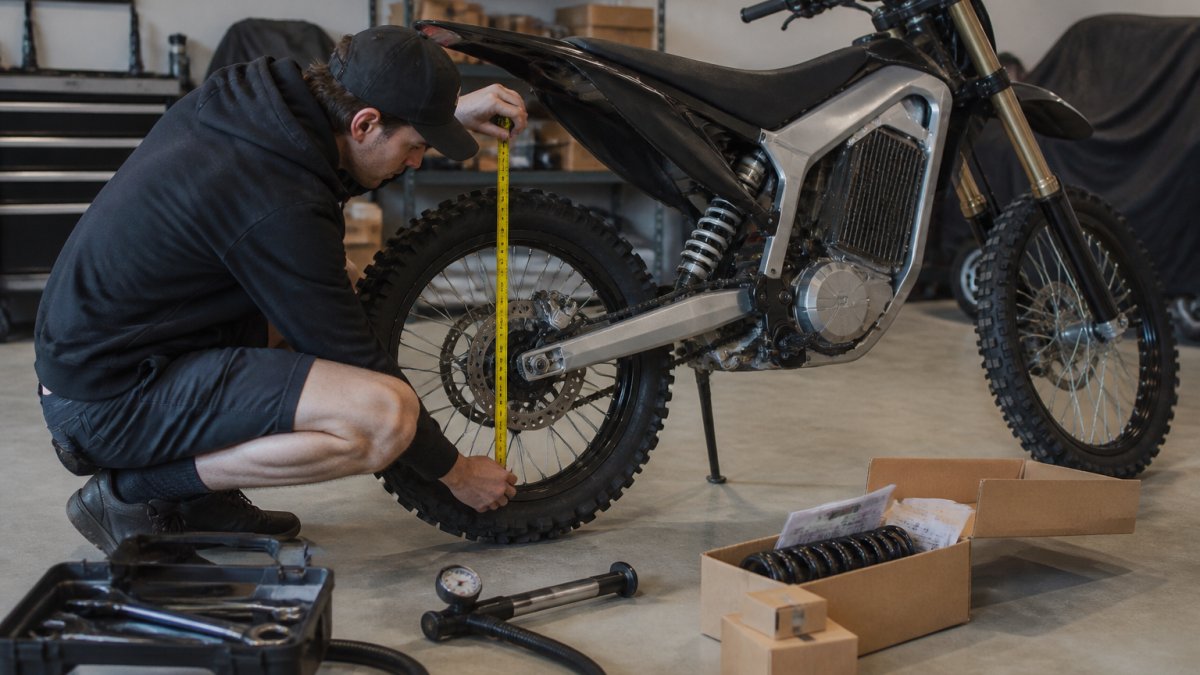
To measure rear sag, record the distance from the rear axle to a fixed point on the tail with the bike unloaded, then have the rider sit in their normal position with gear on and measure again. The difference is your sag figure.
Spring Rate, Damping and What Sag Tells You
Sag is a readout of spring rate, not damping. If you cannot reach your target sag within the shock's adjustment range, the spring is wrong for your weight, and no clicker tuning will fix it. Damping controls how fast the suspension moves, not how far: rebound that is too fast kicks the rear up after a hit, too slow and it packs down over repeated bumps.
Electric Dirt Bike Head Angle: Stability Versus Steering Speed
Head angle is the angle of the steering axis relative to vertical. A slacker angle puts more trail in front of the contact patch and adds straight-line stability; a steeper angle reduces trail and speeds up steering. On an e-moto, a slack angle that feels planted on a gas bike can feel like the front end is wandering, so riders coming from heavier machines often run a steeper angle than they expect. You rarely set head angle directly: you change it by raising or lowering the fork in the triple clamps, or by changing rear ride height through the linkage, and both move the angle and the wheelbase at once.
Electric Dirt Bike Wheelbase and Handling: Turning Versus Tracking
Wheelbase is the horizontal distance between the front and rear axle centers. A longer wheelbase tracks straighter and resists wheelies. A shorter one turns quicker and feels more playful in tight terrain.
Rear linkage is the most common way riders change wheelbase on an e-moto without touching the frame.
Warp 9 Racing product information lists these linkage options for riders comparing rise heights.
The trade-off is real. Add wheelbase for stability and you give up some of the flickability that makes a light e-moto fun in the woods. Shorten it and the bike turns on a dime but gets nervous at speed.
TMB Linkage for Sirris R38 Rear Shock, Arctic Leopard XE Pro →
Fork Height and Handling: The Adjustment You Can Make in Ten Minutes
Fork height is how far the fork tubes sit above the top triple clamp. It is the fastest geometry adjustment on the bike and reversible in minutes. Slide the forks up and you lower the front, steepening the head angle and quickening steering; slide them down and you raise the front, slackening the angle and calming the bike at speed. A few millimeters is a meaningful change. Experiment with this first, because it costs nothing and teaches you how the bike responds before you spend money on parts. Change it in small steps, ride the same loop, and note what changed.
Suspension Kinematics, Linkages and Why Hardtail Versus Full Suspension Matters
Suspension kinematics describes how the rear linkage moves the shock through its travel. It is separate from frame geometry, and confusing the two is the most common mistake riders make when they try to fix a handling problem by buying parts. Frame geometry is where the axles, steering axis, and pivot points sit at rest; kinematics is how those points move as the suspension compresses. Two bikes can share identical geometry and completely different kinematics, and feel nothing alike on the trail.
Leverage ratio. The ratio of rear axle travel to shock stroke.
Anti-squat. How much chain or belt tension and linkage geometry resist rear compression under acceleration.
Axle path. The curve the rear axle follows as the suspension compresses.
Progression. How much the leverage ratio changes through the stroke.
Full suspension gives you a rear shock and a linkage to tune that ratio.
Shock and Fork Compatibility Before You Buy
Compatibility is where geometry gets expensive if you get it wrong. A rear shock is not a universal part. It has a specific eye-to-eye length, stroke, and mounting configuration, and the linkage it works with has to match. Changing shock length changes ride height, which changes head angle and wheelbase. Changing stroke changes travel, which changes how the linkage moves through its range. The TMB R38 linkage is a clear example: it fits the Sirris R38 rear shock on Arctic Leopard XE Pro S, Enduro, and R models, and the stock lower linkage is not compatible with the R38, so the linkage is required for that swap. It also does not work with the stock Arctic Leopard shock. A shock and a linkage are a matched pair, so before you buy either, confirm the exact model and year and that the two parts are designed to work together.
| Part | Fits | Geometry Effect |
|---|---|---|
| TMB R38 Linkage | Arctic Leopard XE Pro S, Enduro, R with Sirris R38 shock | Required for R38 swap |
| KyVex Billet Linkage | Sur-Ron Light Bee X (2019-2025) | Same as stock |
| KyVex Billet Triangle | Sur-Ron Light Bee X (2019-2025) | Same as stock |
| Warp 9 Ultra Bee Linkage | Sur-Ron Ultra Bee | OEM height |
| Warp 9 Talaria Sting Linkage | Talaria Sting, Sting R, MX5 | Stock height or rise |
Some of these parts preserve stock geometry and some change it. The KyVex pieces keep the same mounting points and geometry as stock, so they are durability upgrades rather than handling changes. The Warp 9 Talaria linkage offers a rise option that corrects geometry after a wheel change. Before you order any shock or linkage, measure and record five numbers on your bike: eye-to-eye shock length, shock stroke, lower mounting width, upper mounting width, and bolt diameter.
Matching Electric Dirt Bike Suspension to Your Riding Style and Terrain
Setup follows terrain and riding style, not a spec sheet. A rider on tight, technical trails wants quicker steering and a shorter effective wheelbase; a rider on fast, open ground wants stability and a slacker angle. Start with sag, then set fork height, then consider a linkage change only if you need to correct geometry after a wheel swap or shock upgrade. Buy parts by confirmed fitment against your exact model and year, never by assumption. RYVOX is an authorized dealer for Arctic Leopard, Yozma, and Ventus, and we carry suspension parts from brands like Warp 9 and TMB. If you are unsure whether a linkage or shock matches your bike, message us with your model and year and we will confirm fitment before you order.

Frequently Asked Questions
How do you set sag on an electric dirt bike?
Measure the rear axle to a fixed point on the frame with the bike unloaded, then again with the rider in full gear standing on the pegs. The difference is your sag. Adjust preload until it lands in the range the shock manufacturer lists for your model. E-motos carry more weight low and center than gas machines, so recheck sag after any battery or motor change. Write the number down so you can return to it.
Does a 1 degree head angle make a difference?
Yes, and most riders feel it. Slackening the head angle by 1 degree slows steering slightly and adds straight-line stability at speed. Steepening it by the same amount quickens turn-in and makes the front feel lighter on climbs. On an electric dirt bike, where instant torque can lift the front easily, a slacker angle often suits aggressive throttle use. Change one degree at a time and test on the same trail.
How does wheelbase affect e-moto stability and turning?
A longer wheelbase tracks straighter and resists pitching under hard acceleration, which suits fast fire roads and open terrain. A shorter wheelbase turns tighter in technical sections but feels busier at speed. You usually change wheelbase through linkage, axle position or wheel size rather than the frame. If you fit an offset wheel set, a linkage that restores stock head angle keeps the handling predictable.
Can changing fork height affect handling?
Sliding the fork tubes up or down in the triple clamps shifts weight between the front and rear. Raising the forks lowers the front, sharpens turn-in and can make the bike twitchy at speed. Lowering them in the clamps raises the front and calms the steering. Move in small increments, 5 mm at a time, and keep both legs even. Recheck sag afterward because the change affects balance.
What suspension setup works best for rough trails?
Rough trails reward compliance over stiffness. Run sag in the recommended range, back off compression damping so the fork and shock absorb repeated hits instead of deflecting, and keep rebound quick enough that the suspension extends before the next bump. On an electric dirt bike the extra unsprung weight at the rear makes damping quality matter more. Test on the same loop and change one setting at a time.
How do I know which linkage fits my bike?
Fitment is model and year specific, so check the product page before ordering. The TMB linkage for the Sirris R38 rear shock fits Arctic Leopard XE Pro S, XE Pro S Enduro and XE Pro R, and it does not work with the stock Arctic Leopard shock. KyVex linkages fit the Sur-Ron Light Bee X from 2019 to 2025. Warp 9 makes linkages for the Sur-Ron Ultra Bee and the Talaria Sting, Sting R and MX5. Confirm your exact model and year before you buy.
Getting geometry right is the difference between a bike that fights you and one that works with you. If you are not sure where to start, RYVOX can help you work through sag, fork height, and linkage options for your exact model and year. We stock genuine suspension parts, verify fitment before shipping, and offer in-house service and installs for riders who want it done right the first time. Get started with RYVOX and dial in a setup built around how you actually ride.