
Best Electric Dirt Bike for Beginners: 2026 Buyer's Guide
Find the best electric dirt bike for beginners. Learn sizing, safety gear, maintenance, and what to look for before you buy your first e-moto.

Table of Contents
- What Makes an Electric Dirt Bike Beginner-Friendly
- How to Choose an Electric Dirt Bike Size for Your Height and Weight
- Electric Dirt Bike Safety Gear for Beginners
- Battery, Voltage, and Range: What Beginners Need to Know
- Electric Dirt Bike Maintenance Tips for New Riders
- Insurance, Liability, and Trail Etiquette for Off-Road E-Bikes
- The Bottom Line on Buying Your First Electric Dirt Bike
- Frequently Asked Questions
Last Updated: September 13, 2026
What Makes an Electric Dirt Bike Beginner-Friendly
The best electric dirt bike for beginners delivers smooth, predictable power, manageable seat height and weight, and a voltage and battery setup that matches your actual riding time.
This RYVOX guide covers power delivery, sizing, safety gear, battery care, and maintenance so you can choose with confidence instead of guessing from spec sheets.
Electric dirt bike is a category term for off-road motorcycles powered by a lithium-ion battery and a brushless motor instead of a combustion engine, which changes how power reaches the rear wheel.
Power, Torque, and Throttle Response
Beginners should prioritize controllable torque over peak output. A motor with modest nominal power and a gentle throttle map teaches throttle control without unexpected wheel lift.
Look for riding modes that limit top speed and soften throttle response, letting a new rider build confidence on trail riding terrain before unlocking full power.
Weight, Seat Height, and Ground Clearance
Low weight and a low seat height most affect early confidence: a lighter bike is easier to pick up, load, and handle on tight trails.
Ground clearance determines what you can ride over without scraping. For a beginner, moderate clearance with a planted chassis beats an aggressive, tall setup.
How to Choose an Electric Dirt Bike Size for Your Height and Weight
Choosing the right size comes down to two measurements: your inseam against seat height, and your body weight against rated weight capacity. Get those right and the bike feels natural within a few rides.
Seat Height and Standover Clearance
A practical rule: you should place both feet near the ground when seated, or one foot flat with the other supporting. If you are on your toes at a standstill, the bike is too tall.
Standover clearance matters when you stop on uneven trail. A lower seat height gives you a safety margin on off-camber ground.
Weight Capacity and Rider Ergonomics
Check the manufacturer's rated weight capacity before buying. Exceeding it affects suspension travel, braking, and chassis durability.
Rider ergonomics covers bar height, lever reach, and footpeg position. Adjustable bars and levers help smaller or larger riders get comfortable without aftermarket parts.
Rider Consideration |
What to Check |
Why It Matters |
|---|---|---|
Height and inseam |
Seat height and standover clearance |
Confidence at stops on uneven trail |
Body weight |
Rated weight capacity |
Suspension, braking, and chassis durability |
Reach |
Adjustable bars and levers |
Comfort and control without mods |
Riding style |
Ground clearance and riding modes |
Matches power to your skill level |
Electric Dirt Bike Safety Gear for Beginners
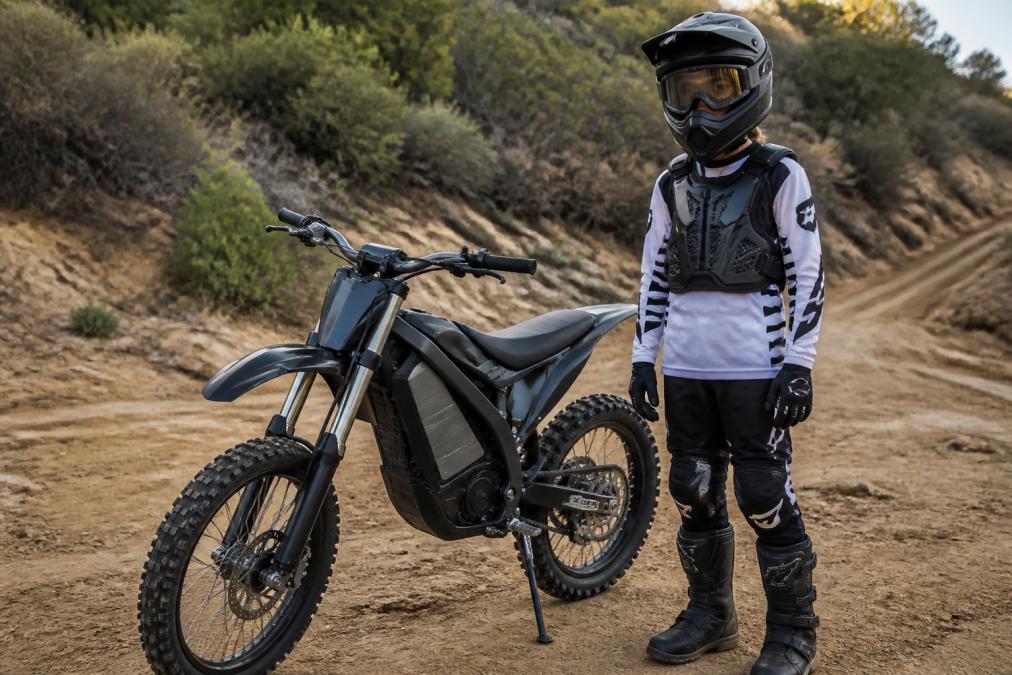
The minimum safety setup is a certified full-face helmet, goggles, gloves, a chest protector, sturdy boots, and knee protection. Off-road riding involves falls, and gear turns a fall into a story instead of an injury.
Helmet certification is non-negotiable: look for recognized safety certification, and replace any helmet that has taken a hard impact (nhtsa.gov).
- Full-face helmet with proper certification
- Goggles or a helmet with a visor
- Gloves for grip and hand protection
- Chest and back protector
- Knee and shin guards
- Off-road boots with ankle support
Gear fit matters as much as gear type. A loose helmet or oversized boots reduce control, the opposite of what a new rider needs.
Battery, Voltage, and Range: What Beginners Need to Know
Battery range depends on voltage, amp-hours, terrain, rider weight, and throttle use, so treat published figures as estimates. Lithium-ion packs are rated in voltage and amp-hours: voltage sets the power ceiling, amp-hours set how long you can ride before a charging cycle. Plan for less range than the spec sheet suggests, since aggressive throttle use, hills, and soft terrain draw more energy than flat, steady riding.
Battery Safety and Fire Prevention
Charge on a non-flammable surface, away from anything combustible, and never leave a charging pack unattended for long periods. Use only the charger specified for your battery.
Store the battery at a moderate temperature and avoid charging a pack that has just been ridden hard or is visibly damaged. A swollen or punctured pack should be taken out of service immediately.
Electric Dirt Bike Maintenance Tips for New Riders
Electric dirt bike maintenance tips center on the battery, brakes, chain or belt, and suspension, checked on a set interval rather than only when something breaks. The electric drivetrain needs far less routine work than a gas engine, no oil changes, air filter, spark plug, or carburetor, but the chassis, brakes, and bearings wear like any off-road motorcycle, and those fail first on a used or hard-ridden machine.
A Beginner Maintenance Schedule
Most manufacturers publish a break-in service and a recurring interval chart. A practical pattern:
- Before every ride (2 minutes): squeeze the front brake lever and confirm it feels firm, not spongy; check tire pressure with a gauge; spin the wheels and listen for grinding; look for fresh fluid under the fork and shock.
- After the first 5-10 hours (break-in): re-torque the axle nuts, triple-clamp bolts, and handlebar clamp bolts to the manufacturer's spec, check spoke tension if the wheels are spoked, and inspect the chain for the initial stretch.
- Every 10-15 hours: clean and lubricate the chain or check belt tension and alignment, inspect brake pads for remaining material, check brake fluid level and color, and inspect the fork and shock for weeping seals.
- Every 25-50 hours: replace brake fluid, service or replace fork oil, repack or replace wheel bearings and the steering stem bearings, and inspect the battery connectors for corrosion.
- Annually or at the start of the season: have the suspension serviced by a shop, replace the chain and sprockets as a set if worn, and load-test the battery if range has dropped noticeably.
What Actually Fails First
On beginner-owned e-dirt bikes, the battery and motor are usually fine while the brakes, chain, and suspension are neglected. Three failure modes worth knowing:
- Spongy or fading brakes. Brake fluid absorbs moisture over time, which lowers its boiling point. On a long descent, old fluid can boil and the lever goes to the bar. Flush it on schedule, not when it feels bad.
- Chain stretch and sprocket wear. A chain that is too tight loads the countershaft bearing; too loose and it can derail or slap the swingarm. Check slack at the midpoint of the lower run and adjust to the manual's spec.
- Fork and shock seal leaks. A thin oil ring on the fork tube after a ride means the seal is weeping. Left alone, the oil level drops and damping fades, which shows up as a vague, wallowy front end on rough terrain.
Battery Care Between Rides
Battery care is the one maintenance area unique to electric dirt bikes, and where beginners do the most damage.
- Do not store at 100% or at 0%. Lithium-ion packs age fastest at the extremes. For a bike that sits for weeks, a partial charge in the middle of the range is the standard recommendation in most owner's manuals.
- Charge at room temperature. Charging a pack that is frozen or that just came off a hard ride stresses the cells. Let it rest and come to ambient temperature first.
- Keep the terminals clean and dry. Corrosion at the connector adds resistance and heat.
- Watch for range loss. A gradual drop over years is normal; a sudden drop after one ride usually points to a cell problem and warrants a dealer check.
Tools Worth Owning
You do not need a full shop to keep a beginner e-dirt bike healthy. A low-range torque wrench, tire pressure gauge, chain lube and brush, metric hex and socket drivers, and a stand that lifts the bike so the wheels spin freely cover most routine work. Battery pack internals, the motor controller, and suspension revalving are best left to a dealer.
Insurance, Liability, and Trail Etiquette for Off-Road E-Bikes
Insurance and land-access rules for off-road e-bikes vary by state and land manager, so verify local requirements before you ride. Here is the practical sequence, what to check, who to ask, and what to have in hand, plus the delivery-and-setup step most guides skip.
What to Verify Before Your First Ride
- Whether the land allows motorized use at all. Many hiking, equestrian, and wilderness-designated areas prohibit motorized vehicles outright, regardless of whether the bike is electric. Electric does not automatically mean allowed.
- Whether the bike needs registration or a permit. Some states require off-highway vehicle registration or a permit for off-road motorcycles on public land, and some require a title or certificate of origin. Rules differ for private tracks, private land, and public trails.
- Whether a spark arrestor or other equipment is required. Even on electric bikes, some land managers require specific equipment. Check the current rules for the specific area, not a general summary.
- Whether your homeowner's or renter's policy covers off-road vehicles. Many standard policies exclude motorized vehicles, or cover them only on your own property. A separate off-road vehicle policy or a rider added to an existing policy is the common fix.
- Whether the track or club requires liability coverage. Private tracks and riding clubs often require proof of insurance or a signed waiver before you ride.
Liability Basics for Beginners
If you cause an injury or property damage while riding, you can be personally responsible for the costs, the practical reason insurance matters for a beginner. Two things reduce your exposure: carry coverage that applies to off-road motorized use, and ride within your ability on terrain you can see. Most trail collisions happen on blind corners and crests.
- Carry proof of any required registration or insurance on the bike or in your pack.
- If you ride on private land, get permission from the landowner in writing, and confirm whether their policy covers guests.
- If you let someone else ride your bike, understand that your coverage may not extend to them.
Trail Etiquette That Protects Access
Trail etiquette is not just manners, it keeps trails open to motorized use. Land managers watch rider behavior, and complaints from other user groups drive closures.
- Yield to non-motorized users. Slow down, move to the side, and stop if needed. A horse can spook at a bike it did not hear coming, so announce yourself early and calmly.
- Stay on designated routes. Cutting switchbacks and riding off-trail causes erosion that land managers cite in closure decisions.
- Keep speed down near trailheads and parking areas. Most conflicts happen where riders and other users mix.
- Pack out what you bring in. Tubes, zip ties, and packaging do not belong on the trail.
- Leave gates as you find them. Open gates stay open; closed gates stay closed.
- Ride quiet and ride sober. Electric bikes are quiet, which means other users cannot hear you coming, ride accordingly.
Environmental Impact and Why It Matters
Electric dirt bikes have no exhaust emissions and no fuel spill risk, a genuine advantage on sensitive terrain. But tires still tear up soft ground, and wet-trail ruts persist for months. The rule most land managers ask for: if you are leaving ruts deeper than an inch, the trail is too wet to ride. Staying off wet trails is the easiest way to protect access for the electric dirt bike community.
Out-of-the-Box Setup: What to Expect on Delivery
This is where new riders get stuck. A new electric dirt bike typically ships in a crate or heavy box, mostly assembled but not ride-ready.
What is usually already done at the factory or dealer: the motor, controller, and battery are installed and wired; the wheels and tires are mounted; the brakes are plumbed and bled.
What you typically have to do:
- Uncrate and inspect. Check the box for damage before signing for delivery. Photograph anything crushed or punctured.
- Install the front wheel if it shipped off the bike. Torque the axle to the manual's spec, this is the single most common assembly mistake.
- Install and align the handlebar. Center it, set lever angles, and torque the clamp bolts evenly in a cross pattern.
- Install the front fender and number plate if they shipped loose.
- Connect or install the battery per the manual, and confirm the connectors seat fully.
- Set tire pressure to the manual's recommendation, not the max on the sidewall.
- Check brake lever feel and bed the pads in with a few low-speed stops before riding hard.
- Set sag and clickers to the factory baseline for your weight if the suspension is adjustable.
- Charge to full before the first ride, and do the first ride at low power in a flat, open area.
State off-highway vehicle registration requirements
Public land motorized use rules
The Bottom Line on Buying Your First Electric Dirt Bike
The best electric dirt bike for beginners matches your size, weight, and riding goals, with smooth power delivery and a manageable battery setup. Get fit and safety gear right first, then grow into more performance.
For riders who want expert fitment advice, genuine parts, and a team that actually rides what they sell, RYVOX is the shop to know. RYVOX offers authorized dealer parts from brands like Arctic Leopard, EBMX, and Warp 9, expert fitment verification checked against your exact model and year, and in-house service and PDI.
If you are unsure which bike or upgrade fits your situation, text the shop. The RYVOX team will help you get it right the first time.
Frequently Asked Questions
What should I look for when buying my first electric dirt bike?
Start with rider fit: seat height and weight capacity matter more than peak power for a first bike. Look for a brushless motor with variable speed and multiple riding modes so you can dial back throttle response while learning. Check that the bike has hydraulic disc brakes, adequate suspension travel, and a lithium-ion battery with a documented charging cycle rating. Buy from a dealer that offers genuine parts and warranty support.
Are electric dirt bikes easier to ride than gas bikes?
For most beginners, yes. Electric dirt bikes have no clutch, no gears, and instant torque delivery that you control with a twist of the throttle. There is no kick-starting, no warm-up, and no exhaust noise to manage. The trade-off is that torque comes on immediately, so new riders should use a low riding mode until they are comfortable with throttle response and weight distribution.
Do electric dirt bikes require a lot of maintenance?
Less than gas bikes, but not zero. You skip oil changes, air filters, spark plugs, and carburetor tuning. What you do maintain: chain tension, brake pads, tire pressure, suspension seals, and battery care. Follow the manufacturer's maintenance interval for bearing checks and controller diagnostics. Storing the battery between 20 and 80 percent charge and avoiding extreme temperatures extends its life.
What is the best electric dirt bike for a budget?
Budget-friendly beginner models typically use a lower-voltage lithium-ion battery and a less powerful brushless motor, which is fine for learning. Prioritize safety features over peak power: hydraulic disc brakes, a throttle limiter or riding modes, and a frame that fits your height. Avoid unbranded batteries. Ask the dealer whether the bike comes with a warranty and whether replacement parts are available.